
Safer Gambling Tools for NFL Bettors in the UK: What's Built In and How to Use It
 Available in US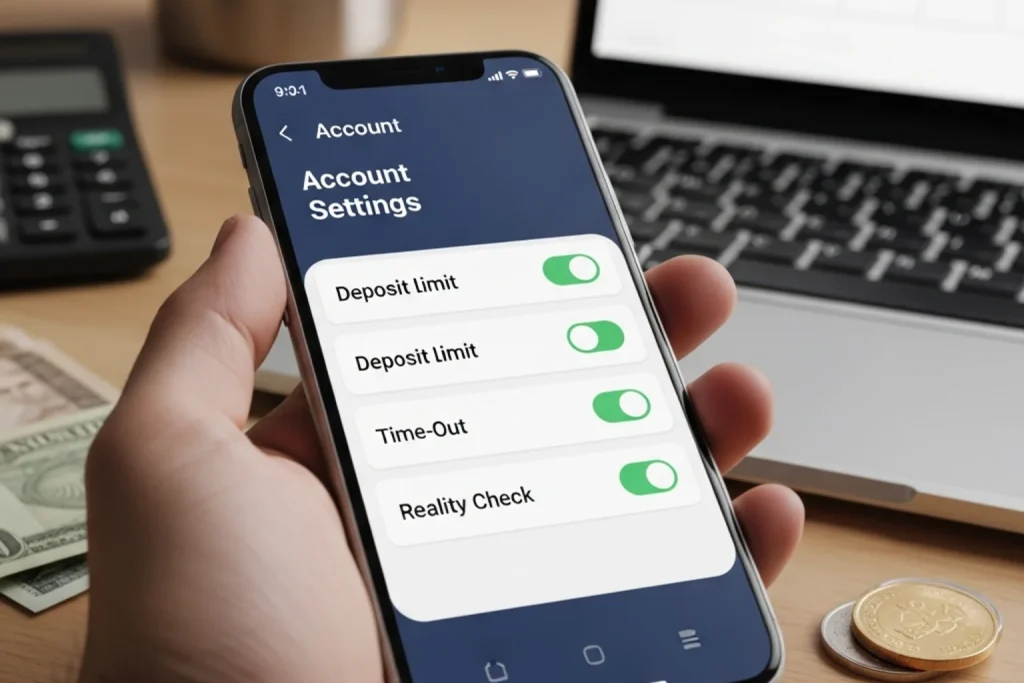
The deposit limit I should have set in 2018
In my first full NFL season as a UK punter I had no deposit limit set on my main sportsbook account. I had a process — bankroll discipline, weekly review, fixed unit sizing — and I trusted myself to follow it. By the time I hit Week 14 I had broken every rule I had written down. The Sunday slates were producing late-window losses and I was chasing them with deposits I should not have been making. I closed that season down £600 against an original plan to risk no more than £300. The technical tool that would have stopped me — a £75 weekly deposit limit on the account — took 30 seconds to set up the following August, and I have had one running on every UK account I have held since. There are roughly 340,000 adults in the UK classed as problem gamblers and another 1.8 million classed as ‘at risk’ per the UKGC’s 2024 prevalence work. Among 18-24-year-olds the rate is significantly higher — 21.9% have a PGSI score of 1 or above, and 5.3% sit at score 8 or higher. The tools that UK-licensed sportsbooks make available are the most underused defence in NFL betting from the UK.
This is not a guide to whether you should be betting. That decision is yours, and the framework I am about to walk through assumes you are betting and that you want the structural protections that UKGC-licensed sportsbooks have built in. The tools fall into five groups: deposit limits, reality checks and time-outs, financial vulnerability monitoring, the slot stake limits introduced in April 2025, and external support organisations. I will walk through each in the order I would actually set them up on a new account.
Deposit limits: the single most useful tool
The deposit limit is the first tool I would set on any new UK sportsbook account, and the one tool I would not be without. The mechanic is simple: you nominate a maximum amount that can be deposited within a chosen rolling window — daily, weekly or monthly — and the operator’s payment system refuses any deposit that would push you over the limit. The limit can be set to any figure you choose, including amounts well below the operator’s default minimum deposit threshold.
The crucial regulatory point is that the limit can be lowered instantly, but raising it takes a cooling-off period. UK sportsbooks are required to apply a 24-hour delay on any request to raise or remove a deposit limit. Some apply longer cooling-off periods voluntarily — 48 hours or 72 hours is common. The asymmetry is deliberate. The 24-hour delay means that an impulse to deposit beyond the limit during a frustrating Sunday afternoon cannot be acted on in the moment; it has to survive a night’s sleep first. In my experience, most impulses to break a deposit limit do not survive a night’s sleep.
I run weekly deposit limits rather than monthly because they reset more often and produce more frequent moments of self-awareness about my own spend. A £100 weekly limit forces me to confront the cumulative figure 52 times a year. A £400 monthly limit forces me to confront it 12 times. The first design produces better discipline by a clear margin.
The limit should be set in cash terms that match what you would happily lose in a fortnight — not what you can technically afford, and not what your highest-spend week of the previous season was. Most punters set the limit too high because they anchor on the worst case. The right anchor is the recreational-loss case: how much you would still be enjoying the betting at, if you ran a normal losing fortnight.
Reality checks and time-outs
The reality check is a recurring pop-up that interrupts an extended session to display elapsed time and net cash position. UK sportsbooks are required to offer reality checks at intervals the customer selects — typically 15, 30 or 60 minutes. The default at most operators is 60 minutes, which I think is too long. I run reality checks at 30 minutes on every account.
The check is genuinely useful for one reason: it interrupts the autopilot. NFL betting from the UK overlaps with bedtime hours for early-window Sunday games — kickoff at 18:00 UK time means the late games run past midnight, the Monday Night Football package finishes around 4am. Long sessions during that window produce decisions that you would not make awake at 10am the next morning. A reality check at 30 minutes is a structural prompt to ask whether the bet you are about to place is one you would still be making in the morning.
The time-out is a temporary self-exclusion from the sportsbook account — typically 24 hours, 7 days, 30 days or 90 days, depending on the operator. UK sportsbooks are required to offer time-outs at all of those lengths. Once activated, you cannot log in, deposit or bet for the duration. Existing pending bets are settled normally; the balance is frozen until the time-out expires.
I have taken one time-out, in 2020, after a bad Sunday where I had broken a deposit limit by depositing at a second sportsbook to circumvent the first. A 7-day time-out on both accounts gave me the space to reset before the next Sunday. The mechanic worked exactly as intended. If you find yourself moving deposits between operators to get around your own limits, a time-out is the right next step.
Financial vulnerability checks
UK sportsbooks are required under LCCP to monitor customer activity for signs of financial vulnerability and to intervene where deposit or loss patterns suggest harm. The specific triggers and intervention tools are set by each operator within UKGC guidelines, but the obligation is industry-wide. The statutory gambling levy of 0.1% to 1.1% of operator gross gambling yield that came into force in April 2025 funds the wider treatment and research infrastructure around problem gambling, including some of the data work that underlies operators’ vulnerability monitoring.
What does this look like in practice? The most visible form is the affordability check. If your deposit volume crosses certain thresholds — typically several hundred pounds per month, with light-touch checks triggering earlier — the operator may pause your account and request additional information about your finances. The check can be a simple confirmation of employment status, or it can be an enhanced check requesting recent bank statements or payslips. Once the check is complete and the operator is satisfied the activity is affordable, the account resumes normally.
The other visible form is the safer-gambling intervention message. Most UK sportsbooks send automated emails or in-app messages when activity patterns shift in ways the operator’s monitoring flags — a sudden increase in deposit frequency, a high number of bets placed late at night, a pattern of losses followed by larger deposits. The messages typically point to the deposit limit and time-out tools and to external support resources. They are not requests for action; they are prompts.
I have received exactly two of these prompts over my UK betting career, both during periods when my activity had genuinely shifted in ways I had not consciously registered. Both times the prompt was useful. The operator was not threatening to close my account or block my withdrawals; they were flagging a pattern I had missed. That is the right calibration of the tool.
Slot stake limits and what they signal for sports betting
The April 2025 reforms introduced a maximum stake of £5 per spin for online slots for users aged 25 and over, and £2 per spin for users aged 18 to 24. The Parliamentary Under-Secretary of State at the Department for Culture, Media and Sport described online slots as the highest-risk gambling product when introducing the regulations, noting that they have the highest rate of binge play and the highest average losses of any online product, and are associated with long playing sessions and high levels of use by people experiencing gambling harm.
Why does this matter for NFL sports betting? The operators delivering NFL betting in the UK almost all run casino products alongside, including online slots, and the same account that you fund for sports can typically place slot stakes on the same balance. The regulatory direction of travel signalled by the slot reform — deliberate friction, lower stakes, more pauses — is the same direction future sports betting reforms are likely to take. Most punters with disciplined NFL betting habits keep their sports account separate from their casino exposure by simply not playing the casino product.
External support organisations
The internal tools — deposit limits, reality checks, time-outs — are the first line of defence. The external organisations are the second line, and they handle the cases that the internal tools cannot.
GamCare runs the National Gambling Helpline on 0808 8020 133, free to call from UK landlines and mobiles, open 24 hours a day. The helpline is staffed by trained advisers and provides confidential support. GamCare also runs an online chat service and a network of in-person treatment partners. The Betting and Gaming Council reported that its member operators voluntarily contributed over £170 million in the four years to November 2024 to research and treatment of problem gambling, much of which funds GamCare’s service infrastructure and the wider treatment network.
GambleAware is the commissioning body that funds the National Gambling Treatment Service. The treatment service includes the helpline, residential treatment programmes, brief intervention work and the research that informs how the wider system operates. The service is free at the point of use for anyone in Great Britain.
GAMSTOP is the multi-operator self-exclusion scheme. A single registration with GAMSTOP applies to every UK-licensed gambling operator, which means you cannot circumvent a self-exclusion by signing up at a different sportsbook. I cover GAMSTOP specifically in my guide to GAMSTOP for NFL bettors, which walks through how the registration works in practice.
The smaller organisations are worth knowing about too. Gordon Moody runs residential treatment programmes for people with the most severe gambling problems. The Gordon Moody helpline operates alongside GamCare’s for people whose situation has escalated beyond what a brief intervention can address. None of these organisations should ever be a first stop — the internal tools on your sportsbook account are the right first step — but they exist for the cases where the first step is not enough.
The order I would set the tools up
On any new UK sportsbook account, my setup sequence is: deposit limit first, reality check second, identity verification third, then start betting. The deposit limit goes on before the first deposit because once money is in the account, the urgency to use it shifts the decision-making. The reality check goes on after the limit because it is the smaller intervention and slots into the existing session pattern more naturally. The identity verification goes on third because it is the boring step that becomes painful only if you skip it and then need to withdraw under deadline pressure.
The whole sequence takes under five minutes on a modern UK sportsbook app. The amount of frustration it prevents over a season is disproportionate to that five minutes. NFL betting from the UK works best when the structural decisions — how much, how often, how long — are made calmly at the start of the season and locked in by the tools, rather than re-made repeatedly during the emotional moments of a Sunday slate. The deposit limit you set in August is the most useful piece of betting analysis you will do all year.
Can I lower my deposit limit instantly?
Yes. UK-licensed sportsbooks are required to apply any request to lower a deposit limit immediately, with no cooling-off period. Requests to raise or remove a deposit limit are subject to a minimum 24-hour cooling-off period; some operators apply 48 or 72 hours voluntarily. The asymmetry is deliberate — protection takes effect instantly, removal of protection takes time.
What is a financial vulnerability check?
A financial vulnerability check is a process some UK sportsbooks initiate when deposit or loss patterns cross internal thresholds. The check may be a simple confirmation of employment status or a more detailed request for recent bank statements or payslips. The purpose is to confirm that the customer"s betting activity is affordable. The operator is required under UKGC licence conditions to monitor for affordability and to intervene where patterns suggest harm.
Where can I get free confidential support about gambling?
GamCare runs the National Gambling Helpline on 0808 8020 133, free from UK landlines and mobiles, open 24 hours a day. The service is confidential and staffed by trained advisers. GamCare also runs an online chat and a network of in-person treatment partners. The service is funded through industry contributions and the statutory gambling levy.
Articles
Prepared by the NLF Betting Help editorial staff.
