
NFL Betting UK: Professional Strategies and Market Odds
 Available in US
The Evolution of UK NFL Betting Markets and Sportsbook Odds
I started covering NFL wagering from a UK desk in 2016, back when most British sportsbooks treated American football as a curiosity squeezed between greyhounds and politics. A typical Sunday slate offered moneylines, a couple of spreads, and a handful of player props if you were lucky. Pricing came late, liquidity was thin, and asking a cashier about a teaser bet earned you a slow blink.
Ten years later the picture has reset. NFL UK puts the domestic fanbase at around thirteen million, with roughly four million of them avid followers. Independent research goes further, pinning the broader audience at 14.3 million — close to one in five Britons. Sky Sports has just extended its rights deal through 2027-28, every major UKGC-licensed operator now runs a dedicated NFL desk, and the betting menu on a marquee London game can stretch past two thousand markets before kickoff.
This guide is the playbook I wish I'd been handed in 2016. The rules, the formats, and the small print that separates a tidy Monday morning from a refund dispute. It's written for the British punter, in British English, with the UK Gambling Commission framework treated as the home jurisdiction.
I'll cover what NFL betting means under UK rules, the legality question, the three core bet types, fractional versus decimal pricing, accumulator settlement when a leg pushes or voids, futures and Super Bowl markets, the London and Dublin game effect, and the 2025-26 responsible-gambling reforms. Sections that warrant a deep dive point to dedicated guides on the site.
American football imports terminology from a US market that has been federally legal for less than a decade. UK sportsbooks have layered British conventions on top — fractional pricing as default, accumulator instead of parlay, void instead of refund. Where the two diverge, I flag it the first time.
The Headlines Before the Long Read
- NFL betting is legal in the UK through any UKGC-licensed sportsbook for anyone aged eighteen or over, settled in pounds sterling with consumer-protection rules attached to every stake.
- Winnings are tax-free for the punter at any size; General Betting Duty falls on the operator at fifteen per cent of gross profit on UK-customer wagers.
- Three core bet types — moneyline, point spread, totals — carry roughly eighty per cent of UK NFL stake; fractional pricing is the British default with decimal and American odds on the betslip toggle.
- Accumulators settle leg by leg. A pushed leg drops out and the bet recalculates over the surviving legs at original prices; a two-leg accumulator with one push becomes a single bet.
- The 2025 reforms set financial vulnerability checks at £150 monthly net deposits and online slot caps at £5 for adults and £2 for eighteen-to-twenty-four-year-olds, with the responsible-gambling code reaching across every NFL product.
What NFL Betting Actually Means When You Click Through From a UK Sportsbook
A friend asked me last September whether NFL betting in the UK is "the American kind or the football kind." Fair question, badly worded. The answer is the American kind, but the betting around it is unambiguously British — pounds sterling stakes, UKGC consumer protection, fractional odds as default, GAMSTOP self-exclusion, the works.
NFL betting is wagering on outcomes within the National Football League — the thirty-two-team American football competition that runs from early September through the Super Bowl in February. The league splits into AFC and NFC conferences, each with four divisions of four teams, twelve playoff places, and one championship trophy. From a UK punter's seat it sits inside the same regulatory perimeter as the Premier League or Cheltenham. The bookmaker holds a UKGC licence, takes your stake in pounds sterling, and applies the same fair-settlement code to your NFL accumulator as to your Saturday football treble.
The shape of the British betting public hasn't shifted dramatically over the past decade even as NFL volumes have ballooned. Forty-eight per cent of British adults gambled in some form during a four-week window in late 2025, with twenty-seven per cent participating in something other than the National Lottery. Sports betting carries a stark gender skew — sixteen per cent of men placed sports bets in the same window against four per cent of women, a four-to-one ratio. NFL skews younger than that average and pulls a higher share of first-time bettors than horseracing, which is part of why operators have leaned in so hard.
A few terms you'll see throughout, defined the way British sportsbooks actually use them.
Punter — the customer placing the bet. UK operator copy almost always says punter; trade press uses "bettor" interchangeably.
Stake — the money you risk on a bet. A £10 stake is what you've placed at risk, not the potential return.
Returns — what comes back when you win, stake included. A £10 stake at 5/1 pays £60 returns: £50 profit plus the £10 stake.
Sportsbook — the operator taking the bet. American import, but it's stuck. Bookmaker is the British equivalent.
Accumulator (US: parlay) — a multi-leg bet where every leg must win for the bet to pay. Two-leg accumulators are doubles, three-leg are trebles, four-plus are fourfolds. Same product, different label.
A note on jurisdictions. UK Gambling Commission rules apply to operators licensed in Great Britain — England, Scotland and Wales. Northern Ireland has its own framework under the Betting, Gaming, Lotteries and Amusements (Northern Ireland) Order 1985, although most UKGC-licensed operators serve Northern Irish customers under voluntary safeguards. The rules in this guide are written for the GB framework.
The Legality Question Settled in One Word
The single most common message I get from new readers each September goes some variant of: "Wait, can I actually bet on the NFL legally in the UK?" Yes. Categorically. NFL betting is legal in the UK and has been since the modern licensing framework took shape under the Gambling Act 2005, with the substantive 2014 amendments closing the offshore loophole that previously let some operators sidestep British duty.
Any sportsbook holding a remote operating licence from the UK Gambling Commission can offer NFL markets to British customers. Any UK resident aged eighteen or over can place those bets. The product is regulated identically to a Premier League moneyline or a Grand National each-way punt.
The scale of the licensed market sits behind that simple yes. Industry-wide gross gambling yield reached £16.8 billion for the financial year running April 2024 to March 2025, up 7.3 per cent year on year. The remote casino, betting and bingo segment — where every online NFL stake lives — accounted for £7.8 billion of that, up 13.1 per cent on the prior year. NFL betting is a small slice of those totals, but the slice is growing faster than the cake.
Andrew Rhodes, the Gambling Commission's chief executive, told the regulatory community in early 2025 that "discussions with operators are showing a widening out of the sports offering in particular, with sports beyond the traditional horseracing and football growing in use, such as cricket, basketball, NFL and a host of other US-based sports." That single sentence captures why UK operators have spent the last three years pouring product investment into American football: it's the visible growth lane in a market where the legacy verticals have flatlined.
What "legal" means in practice. A UK Gambling Commission licence binds the operator to the Licence Conditions and Codes of Practice, age and identity verification, fair-settlement rules under the Bookmakers' Sportsbook Standards, segregated customer funds, AML and source-of-wealth checks beyond defined thresholds, and a duty of care under the social-responsibility code. None of that disappears because the sport bet on is American.
The tax treatment has its own section below. The short version: punter winnings are not taxed in the UK regardless of sport or win size. The duty sits with the operator and applies regardless of where the operator is licensed.
The unlicensed market. A handful of offshore sites still target British punters without a UKGC licence, often with welcome offers that look too good to refuse. These sites operate outside UK consumer protection: no segregated funds, no UKGC dispute resolution, no GAMSTOP coverage. The fastest way to verify a sportsbook is licensed is to find the UKGC account number in the website footer and cross-reference it on the Commission's public register.
None of this means NFL betting is identical to football or horseracing in every detail. The settlement quirks of American football — overtime that counts toward spreads but not most quarter markets, two-point conversions that don't count for touchdown scorer settlement, the dead-heat rule on first-scorer markets — sit awkwardly on top of generic UKGC fair-settlement principles. Operators have built a layer of NFL-specific T&Cs to handle them, and that layer is the subject of the rest of this guide.
Three Bet Types That Carry Eighty Per Cent of UK NFL Stake

When I'm explaining NFL betting to a Premier League punter for the first time, I open with the same line. Strip away the props, the futures, the bet builders and the alternative lines, and you're left with three bets: moneyline, point spread, totals. Master those and the rest is variations on a theme.
These three markets carry roughly eighty per cent of UK NFL stake on a normal Sunday. Each is shaped by the sport's idiosyncrasies — the absence of true draws once overtime is factored in, the scoring distribution that clusters around three and seven-point margins, the four-quarter clock that lets you bet halves and quarters separately. But the British settlement rules underneath are sport-agnostic at the base.
The American Gaming Association projected $30 billion in legal NFL stakes across the United States for the 2025 season, up 8.5 per cent on the prior year. The bulk sits in the three core markets and the British operator menu mirrors the same hierarchy. For a walkthrough of every bet type — including teasers, pleasers, pick'em lines and the alt-line menus — see our guide to NFL bet types for UK punters.
The Moneyline
The simplest NFL bet: pick which team wins outright, no margin involved. Pricing reflects the gap between favourite and underdog plus the operator margin on top.
How a moneyline looks on the betslip
A typical regular-season moneyline might land as Chiefs at 4/9 (decimal 1.44) and Broncos at 13/8 (decimal 2.625). A £10 stake on the Chiefs returns £14.44 — £4.44 profit plus the £10 stake — if they win. The same £10 on the Broncos returns £26.25 on the upset.
Overtime counts toward moneyline settlement. Regular-season ties settle as a push in two-way markets and as a distinct "tie" outcome in three-way markets. Playoff games run unlimited overtime, so ties are impossible in the playoffs.
The Point Spread
The line that does most of the heavy lifting on every NFL Sunday. A handicap that levels the two teams: the favourite gives up a number of points, the underdog gets them, and the bet wins or loses against the adjusted final score.
How a point spread looks on the betslip
Chiefs -6.5 priced at 10/11 (decimal 1.91) and Broncos +6.5 at the same 10/11. If the Chiefs win by seven or more, -6.5 cashes. If they win by six or less or lose outright, +6.5 cashes. Half points exist specifically to prevent pushes on whole-number margins.
With 10/11 each side, the bookmaker margin sits around 4.5 per cent — the standard convention on US-imported lines converted into British fractional.
Totals: Over or Under
A market on the combined points scored by both teams in regulation plus overtime, regardless of who wins or by what margin.
How a total looks on the betslip
A typical NFL total might land at 47.5 priced at 10/11 over and 10/11 under. A 27-24 final (51 total) cashes the over; a 17-13 final (30 total) cashes the under. Overtime points count for totals at every major UK operator. Whole-number totals can push and return the stake; half-point totals can't.
Fractional, Decimal, American — Three Languages for One Price
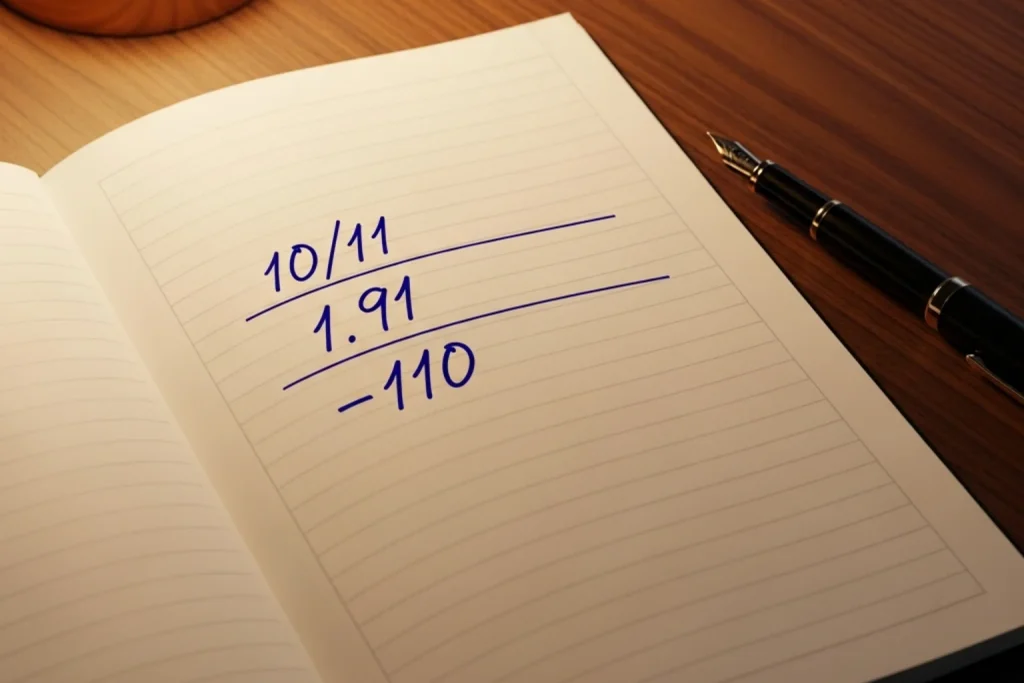
I once watched a punter at a betting shop kiosk shake his head at an NFL line written as -7 (-110) for ten full minutes before asking the cashier what currency the minus sign was in. Fair confusion. The three odds formats on every UK NFL betslip describe the same probabilities in different shorthand.
UK sportsbooks display NFL prices in fractional, decimal and American odds, often on a toggle in the same betslip. The British retail convention is fractional (5/2, 10/11, 13/8) — the notation racing punters have used for a century. The European exchange convention is decimal (3.50, 1.91, 2.625). The American sportsbook convention is the plus-minus moneyline format (+250, -110, +163), imported wholesale with the sport.
The format doesn't change the price. It changes how the price reads. A coin-flip even-money bet is 1/1 fractional, 2.00 decimal and +100 American — all the same line, all the same implied probability of fifty per cent.
The same Chiefs -6.5 spread expressed three ways
Fractional: 10/11. Decimal: 1.91. American: -110. All three describe a bet where £11 staked returns £21 (£10 profit plus £11 stake) when the bet wins.
For a deeper walkthrough of converting between formats, removing the bookmaker margin and using implied probability to identify value, the dedicated guide to NFL odds formats for UK punters covers each conversion in worked detail. The cheat sheet below is enough for the betslip.
| Format | What it shows | How to read it |
|---|---|---|
| Fractional | Profit relative to stake | 5/1 reads as "five units of profit for every one unit of stake" |
| Decimal | Total return per unit staked, stake included | 6.00 reads as "six times your stake back, profit plus stake" |
| American | Stake or win amount against £100 | -150 reads as "stake £150 to win £100"; +250 as "win £250 from £100" |
The conversion shortcut I use day to day: decimal to fractional is subtracting one from the decimal — 2.50 becomes 1.50, which is 3/2. Decimal to American is multiplying decimal minus one by 100 if 2.00 or higher, or dividing minus 100 by decimal minus one if below 2.00. Fractional to implied probability is denominator over the sum of numerator and denominator, so 5/1 implies 16.67 per cent.
This matters for NFL specifically because American football imports its pricing from US markets where -110 is the default margin on spreads and totals. British operators convert that to 10/11 — the same line in fractional clothing. The margin lives inside every price, and the rough convention on a standard NFL spread or total is around 4.5 per cent overround.
Accumulators, Parlays and the Maths That Bites
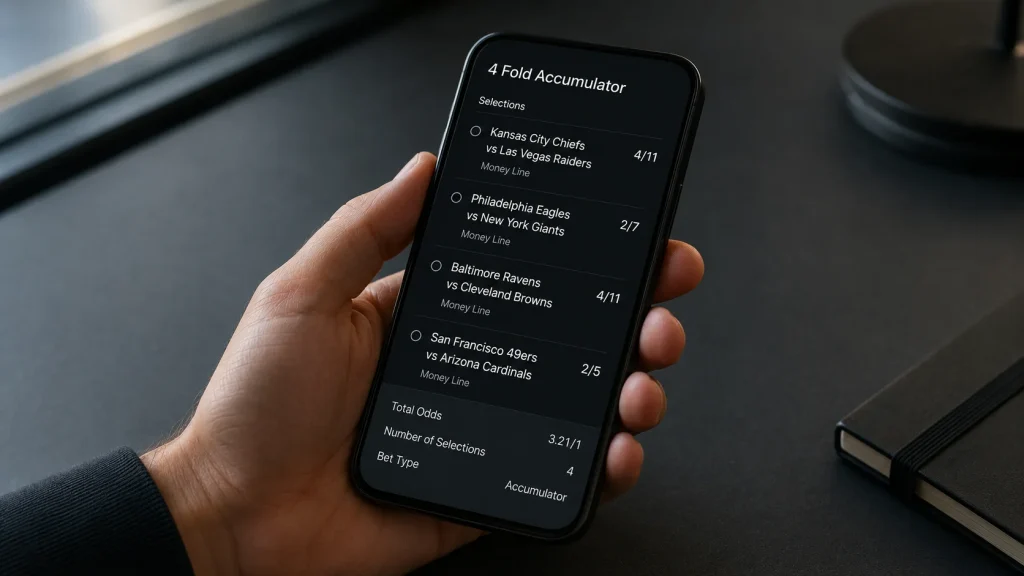
My first five-leg NFL accumulator landed four legs out of five on opening Sunday 2017 and I was certain I'd misread the settlement screen. I hadn't. I'd been bitten by the simple multiplicative reality of accumulator pricing — one leg dies and the bet dies with it, no matter how flattering the other four look on screen.
Accumulators — known as parlays in the American context — combine multiple legs into a single bet where every leg must win for the bet to pay. The mathematical appeal is brutal: a four-leg accumulator at 10/11 per leg pays roughly 14/1, far more than the same stake spread across four singles. The mathematical cost is equally brutal: each independent leg compounds the win probability against you.
British and Irish NFL accumulator volumes have surged in the past two years. One major operator group reported NFL accumulator activity up sixty-five per cent year on year across 2025, with total stakes up forty-six per cent and bet counts up sixty per cent. That growth concentrates in the under-thirty-five demographic and skews heavily toward bet builder formats rather than traditional cross-game accumulators.
Three-leg NFL accumulator at 10/11 per leg, £10 stake
Leg 1: Chiefs -3 — wins. Running odds: 1.91.
Leg 2: Eagles -7 — wins. Running odds: 1.91 × 1.91 = 3.65.
Leg 3: 49ers over 44.5 — wins. Running odds: 3.65 × 1.91 = 6.97.
£10 stake returns £69.70 — £59.70 profit plus the £10 stake. Three £10 singles at 10/11 maximum return £57.30. If leg three loses, the accumulator returns nothing.
When one leg pushes — lands exactly on the spread or total — UK settlement gets specific. A three-leg accumulator with one pushed leg drops to a two-leg and the pushed leg is removed. The stake isn't refunded; the surviving legs determine the outcome. A two-leg with one pushed leg drops to a single. This rule is consistent across UKGC-licensed operators, but small-print wording varies around bet builders.
The void leg rule works similarly but covers cases where a leg can't settle at all — the game cancelled, a market suspended, or an event voided. Void legs are removed and the bet recalculates over the survivors at original prices.
A bet builder, in UK terminology, is a same-game multi where every leg comes from one match and the operator prices the combination as a correlated product. Same-game parlays are the US-imported equivalent, and most British operators run both labels in parallel. Pricing differs from a standard accumulator because correlated legs — a quarterback over passing yards combined with the team to win — would inflate the price unfairly under independent-leg multiplication. Operators recalibrate to reflect the correlation, and some combinations get blocked.
The full mechanics of push handling, void rules, correlated leg restrictions and max-leg caps are covered in our guide to NFL accumulator rules in the UK.
Futures and the Super Bowl Window
Super Bowl LX on February 8, 2026 pulled in 125.6 million viewers in the United States, the second-largest Super Bowl audience on record by Nielsen's measurement. The futures markets I helped price ten months out from kickoff were the most active I'd ever seen from UK punters.
Futures are season-long bets — markets priced before the result is known and settled at the end of the season or qualifying event. The headline is the Super Bowl winner market. Underneath sit conference winner, division winner, season win totals, regular-season MVP, Offensive Player of the Year, and a longer tail of individual statistical leader markets.
The numbers behind Super Bowl betting matter even from the UK because US handle shapes the global pricing reality. Around seventy-six million Americans placed bets on the 2024-25 NFL regular season, with sixty-eight million betting on Super Bowl LIX alone. UK volumes sit inside that gravity field as the secondary market — Britain's growth has been double-digit year on year, but price discovery happens largely on the US side and feeds across to British operators in real time.
Henry Hodgson, NFL UK & Ireland's general manager, captured the UK trajectory after Super Bowl LVIII pulled a record 3.4 million unique UK viewers across Sky Sports and ITV: "The viewership, combined with the social engagement through Super Bowl week, is a testament to the growth of the NFL in the U.K., particularly among the youth demographic that we've targeted this season." That demographic — sub-thirty-five British punters — is the same one accelerating futures volumes.
When futures markets open and close. Super Bowl winner markets open within twenty-four hours of the previous Super Bowl ending. Division and conference winner markets open alongside. Regular-season MVP markets reopen each summer. Season win totals appear at the NFL schedule release in May. Most futures cash out before the playoffs begin, with values that move sharply on injury news.
Settlement on futures has quirks that only surface at this level. Co-MVPs split the prize under the dead-heat rule. A team relocation mid-season — rare but not unprecedented — usually voids regular-season win-total bets at most UK operators. Player props inside the Super Bowl winner market often void if the named player is inactive on the day, while the underlying team market stands.
The full rule set for futures — division winner tie-breakers, MVP award definitions, and cash-out windows operators close before the playoffs — lives in our deep dive on NFL futures and Super Bowl betting for UK punters.
The opening Super Bowl LX futures price on the Kansas City Chiefs in February 2025 — a year out — sat around 11/2 at most UK operators. The same price drifted to 8/1 by the May schedule release and tightened to 7/2 inside the regular season. Futures markets re-price aggressively, and the variance is one of the few places where active line monitoring pays off.
London and Dublin: The Home Games Rewriting the Calendar
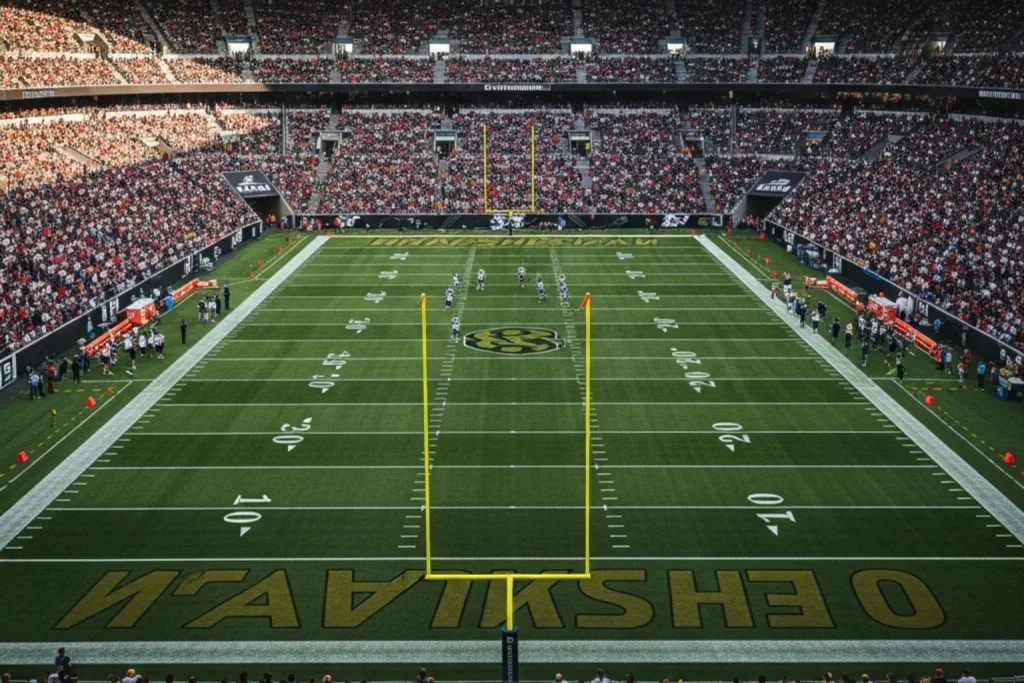
Standing at Croke Park on the morning of September 28, 2025, watching the queue stretch past Drumcondra station before kickoff, I realised the Dublin NFL game had bought itself permanent fixture status in roughly four hours. By the time the Pittsburgh Steelers and Minnesota Vikings took the field, the international NFL calendar had reset around a market nobody had pencilled in two years earlier.
The UK and Irish leg of the NFL's international calendar has shifted from novelty to anchor over the past decade. The first London game ran at Wembley in 2007. By the end of the 2025 season the league had played forty-two regular-season matches in the UK across nineteen seasons, with no London game ever drawing under sixty thousand fans. Tottenham Hotspur Stadium, purpose-built with an NFL-spec pitch underlay, has become the permanent London home; Wembley still hosts the third game when the schedule allows.
The Dublin game ran the Steelers against the Vikings at Croke Park in front of 74,512 fans — the largest NFL crowd in Irish history. The broadcast on NFL Network pulled 7.9 million combined TV and digital viewers, the second-largest international NFL audience on record and sixty-eight per cent above the 2024 international average. Dublin earned an immediate slot on the 2026 international calendar.
9
International games on the 2026 NFL schedule, up from seven in 2025
3
London matches confirmed for 2026, primary venue Tottenham Hotspur Stadium
42
NFL regular-season matches played in the UK through the end of 2025
74,512
Attendance at the Dublin NFL game, the largest NFL crowd in Irish history
7.9m
Combined TV and digital viewers for the Dublin game on NFL Network
That expansion matters for the UK punter because international games shift the betting calendar. A typical NFL Sunday in the US runs from late afternoon UK time through the small hours of Monday. The London and Dublin games kick off at 2:30 PM or 6:00 PM UK time on a Sunday, creating a betting window that aligns with normal British leisure hours. Sportsbook handle runs higher than on equivalent US-staged fixtures because the live-betting audience is awake and engaged.
Hodgson set the public benchmark in a 2024 interview: "We want to be a top-three sport in the UK. We know that right now we're not there, but we have our sights set on that ambitious goal." Reaching it depends on more games, deeper broadcast partnerships and dedicated sponsor activations.
The largest London NFL crowd remains the Jacksonville Jaguars and New England Patriots match at Wembley in October 2023 — 86,651 fans, a record the smaller-capacity Tottenham Hotspur Stadium can't beat. Spurs' NFL-spec capacity tops out around sixty thousand once US end-zone configurations and broadcast infrastructure are factored in.
For the rules: international games settle under the same UK-resident betting rules as US-staged fixtures. Markets close at kickoff UK time, in-play pricing runs through all four quarters and any overtime, and settlement follows the same NFL rulebook regardless of stadium.
Where Settlement Quietly Decides Your Sunday
The most expensive lesson I've watched UK punters learn is that "the bet should be a winner" and "the bet settles as a winner" are two different statements. Settlement is the moment the sportsbook turns the game result into your account balance. NFL settlement under UK rules is overwhelmingly straightforward — fewer than two per cent of UK NFL bets ever generate a customer service contact at settlement. The small percentage that does produce a dispute clusters around the same handful of rules.
The headlines worth committing to memory.
Overtime counts for full-game spreads, moneylines and totals at every major UK operator. If a regular-season game ends 24-24 after sixty minutes and the ten-minute overtime produces a tie or one team scores to win 31-24, the OT result feeds into settlement. Playoff games run unlimited overtime, so ties are impossible in the playoffs.
Pushes settle as void. A spread or total landing exactly on the line returns the stake — no profit, no loss. Inside an accumulator the pushed leg drops out and the bet recalculates over the surviving legs.
First-half, first-quarter and second-half markets settle on the points scored in that segment only. Overtime points don't count for first-half or first-quarter bets, but second-half bets need careful reading — most UK operators include overtime in second-half settlement, a minority don't, and the disclosed wording governs.
Player props settle from the official NFL stat feed. Kneel-downs that lose rushing yards count toward quarterback rushing totals at most operators. Two-point conversions don't count toward anytime touchdown scorer markets — the only "touchdown" that counts is the six-point variety.
Read the operator's NFL-specific rules before your first bet of the season. The general T&Cs cover most sports; the NFL-specific subsection — usually buried under "American Football" — covers overtime, suspended games, weather postponements, dead-heat rules on scorer markets, and what counts as a starting lineup. The time to find out is not after a £200 prop has gone to dispute.
Do
- Read the NFL-specific T&Cs on your chosen sportsbook before the season opens.
- Check whether a market includes overtime before staking a second-half or fourth-quarter line.
- Confirm the dead-heat rule wording for touchdown scorer markets.
- Screenshot the betslip if you suspect a settlement error needs disputing.
Don't
- Assume push rules are identical across operators — mostly they are, the disclosed wording matters when they're not.
- Bet anytime touchdown scorer without checking whether two-point conversions count — they don't.
- Stake prop markets after a player is downgraded on the injury report.
- Chase a disputed settlement through social media before the operator's complaint channel and IBAS.
The American Question About UK Tax
Every time an American friend visits during the football season, the same question lands within ten minutes of me pulling up the betting menu on my phone: "Wait, you don't pay tax on this?" No, you don't. The structural advantage that fact represents is bigger than most British punters realise.
UK gambling winnings are not subject to income tax, capital gains tax or any other form of personal taxation. The HMRC position is consistent across all UK gambling — National Lottery prizes, casino games, sports betting, bingo, fixed-odds horseracing, exchange profits — and covers NFL accumulator wins of any size. A £10 stake on a five-leg fourfold that returns £15,000 is yours in full, with no declaration to HMRC required and no tax withheld at source.
The duty sits with the operator. General Betting Duty is charged at fifteen per cent of the operator's gross profit on UK-customer wagers, including stakes on NFL and other American sports. Remote Gaming Duty runs at twenty-one per cent on remote casino, slot and equivalent products. The duty applies to bets placed by UK residents regardless of where the operator is licensed — the point-of-consumption regime in force since December 2014 closed the offshore loophole that previously let some operators sidestep British tax.
Why this matters in practice. The UK tax structure means an American punter visiting Britain enjoys better effective pricing than they would at most US states, because the operator's tax burden is lower than the combined state and federal regime across much of the US sportsbook market. UK punters using offshore sites — operators without a UKGC licence — give up that tax treatment in principle.
The UK tax-free rule dates from 1957, when betting tax was abolished on the punter side to drive grey-market punters back to legal bookmakers. It survived the 2001 Betting and Gaming Duties Act overhaul because the Treasury determined taxing the operator was administratively simpler. NFL betting inherited the same treatment by default.
The 2025 Reforms Reset the Floor

I write a section on responsible gambling every year and rewrite it every year because the Gambling Commission keeps moving the floor underneath all of us. The 2025 reforms made the most consequential changes since the 2014 amendments to the Gambling Act, and they bleed into NFL betting whether or not American football was the trigger.
The reforms reflect the Gambling Survey for Great Britain finding that around 1.4 million British adults — 2.7 per cent of the population — show signs of serious problem gambling, based on a survey of 19,714 respondents. That figure is higher than the previous methodology suggested and triggered a broad rethink of how the operator-side social-responsibility code is enforced.
The headline changes that touch NFL punters directly.
Online slot stake limits arrived in two stages. A £5 cap for all adults came into force on April 9, 2025, followed by a tighter £2 cap for eighteen to twenty-four-year-olds from May 21, 2025. Slots are not NFL betting, but the slot cap sits inside the same operator app most punters use for American sports.
Financial vulnerability checks now trigger at £150 net deposits in a calendar month, down from £500 monthly when the scheme launched in August 2024. The £150 threshold has been in force since February 28, 2025. The check is "light-touch" — the operator uses publicly available data to verify there's no obvious sign of financial distress — and doesn't require bank statements unless something flags in the initial sweep.
Andrew Rhodes summed up the regulator's case: "This year's findings deepen our understanding of consequences from gambling and provide crucial insight into risk profiles among those who gamble most frequently. We strongly encourage operators to use this evidence to consider the risks within their own customer bases." That's regulator code for: the rule changes are not finished yet.
GAMSTOP, the National Gambling Helpline and the Gambling Commission. Self-exclusion through GAMSTOP — the national online self-exclusion scheme — covers every UKGC-licensed operator and prevents account access for six months, one year or five years. The free National Gambling Helpline runs around the clock on 0808 8020 133. The UKGC publishes the licensed-operator register and handles complaints operators can't resolve.
Pre-season checklist for the 2026 NFL calendar
- Set a deposit limit you can survive losing, not the one you can afford to deposit.
- Set a loss limit on every active account at the start of the season.
- Set a session-time reminder.
- Turn off marketing emails if free-bet offers are pushing you to chase.
- Bookmark the National Gambling Helpline number and the GAMSTOP enrolment page.
- Review deposit history monthly against the limits you set in August.
For the full regulatory framework — UKGC licensing, statutory levy, financial vulnerability checks and the GSGB data — see our deep dive on UK NFL gambling regulation.
How I Compare UK NFL Sportsbooks Without Picking One
Punters ask me which sportsbook to use for NFL more than any other single question. I never name one. Here's the framework I use myself.
The UK NFL operator landscape has consolidated around a handful of brands holding UKGC licences and running dedicated American football desks. The macro signals point to growing investment. Sky Sports extended its NFL broadcast rights through 2027-28 in 2025, increasing live games by roughly fifty per cent and migrating RedZone across to the Sky platform. Flutter Entertainment's Paddy Power brand picked up the NFL UK & Ireland Official Sportsbook Partner designation for 2025-26, the first time the league has appointed a dedicated UK sportsbook partner. PPC click-share data from early 2026 puts William Hill at 37.83 per cent of UK paid sports-betting search traffic and Bet365 at 16.2 per cent — a signal of marketing investment, not necessarily product quality.
Rather than ranking brands, which is not what this guide does, I evaluate UK NFL sportsbooks against a fixed set of criteria.
| Criterion | What to look for |
|---|---|
| Pricing depth | Markets per game on a typical Sunday, depth of player props, alt-line menus, reduced-juice offers on marquee fixtures. |
| Settlement transparency | The operator's NFL-specific T&Cs, dead-heat rule wording, push handling on accumulators and bet builders. |
| Bet-builder flexibility | Legs allowed, eligible markets, correlated-leg restrictions, bet builder vs same-game accumulator differences. |
| Live in-play depth | In-play markets per game, latency between event and price update, suspension triggers during reviews. |
| Cash-out options | Full and partial cash-out availability, auto cash-out triggers, futures cash-out windows around playoff time. |
| Responsible-gambling tools | Deposit limits, loss limits, time reminders, GAMSTOP integration visibility on the main account page. |
| Customer service | Response times, live-chat availability during US prime-time and the small hours of UK Monday morning. |
| Withdrawal mechanics | Speed, accepted methods, identity verification trigger points, source-of-funds thresholds. |
Do
- Check the UKGC account number in the website footer and verify on the Commission's public register.
- Read the NFL-specific T&Cs in full before opening an account for the season.
- Open accounts at two or three operators to compare lines on the same game.
- Use deposit and loss limits from day one rather than waiting for a bad month.
Don't
- Chase a welcome offer without reading the qualifying-bet small print.
- Trust any "best NFL sportsbook" listicle that doesn't link to UKGC licence numbers or disclose commercial relationships.
- Deposit at any operator that won't show responsible-gambling tools on the main account dashboard.
- Ignore the time-zone reality — UK customer service is thin during US Sunday prime-time hours.
Common Questions About NFL Betting Under UK Rules
Is NFL betting legal in the UK?
NFL betting is legal in the UK for anyone aged eighteen or over, placed through a sportsbook that holds a current UK Gambling Commission remote operating licence. The legal framework sits under the Gambling Act 2005 as amended in 2014, with point-of-consumption duty and consumer-protection rules applied to American football identically to football, horseracing or any other sport on the licensed market.
Are NFL winnings taxed in the United Kingdom?
No. UK gambling winnings are not subject to income tax, capital gains tax or any other form of personal taxation, regardless of sport or win size. A £15,000 return on a £10 NFL accumulator is yours in full, with no declaration to HMRC required. The tax burden sits with the operator under General Betting Duty at fifteen per cent of gross profit on UK-customer wagers.
What does a point spread mean in NFL betting?
A point spread is a handicap applied to the favourite to balance the market. If the Kansas City Chiefs are -6.5 favourites against the Denver Broncos, the Chiefs must win by seven points or more for the -6.5 side to cash. The other side — Broncos at +6.5 — wins if the Chiefs win by six or less or lose outright. The half-point exists specifically to prevent pushes on whole-number margins of victory.
How do moneyline bets work for NFL games?
A moneyline bet is the simplest on the menu: pick which team wins outright, no margin involved. Overtime counts toward settlement. Two-way moneylines settle regular-season ties as a push and return the stake; three-way moneylines treat the tie as a third distinct outcome with its own price. Playoff games run unlimited overtime, so ties are impossible in the playoffs.
What happens to my NFL bet if the game ends in a push?
A push — where the result lands exactly on the spread or total — returns the stake with no profit or loss. Inside an accumulator, the pushed leg drops out and the bet recalculates over the surviving legs at their original prices. A two-leg accumulator with one pushed leg becomes a single bet on the surviving leg. A three-leg with one pushed leg becomes a two-leg at original prices on the survivors.
Can British punters bet in-play on NFL matches?
Yes. Every major UKGC-licensed sportsbook offers in-play betting on NFL games, with markets running through all four quarters and any overtime. Lines update drive by drive, suspend during coach's challenges and injury reviews, and confirm bets within a latency window typically measured in low single-digit seconds. The London and Dublin games carry the same in-play depth as US-staged fixtures.
Recommend
Prepared by the NLF Betting Help editorial staff.
