
NFL London Games Betting: Neutral Venue Stats and Edges
 Available in US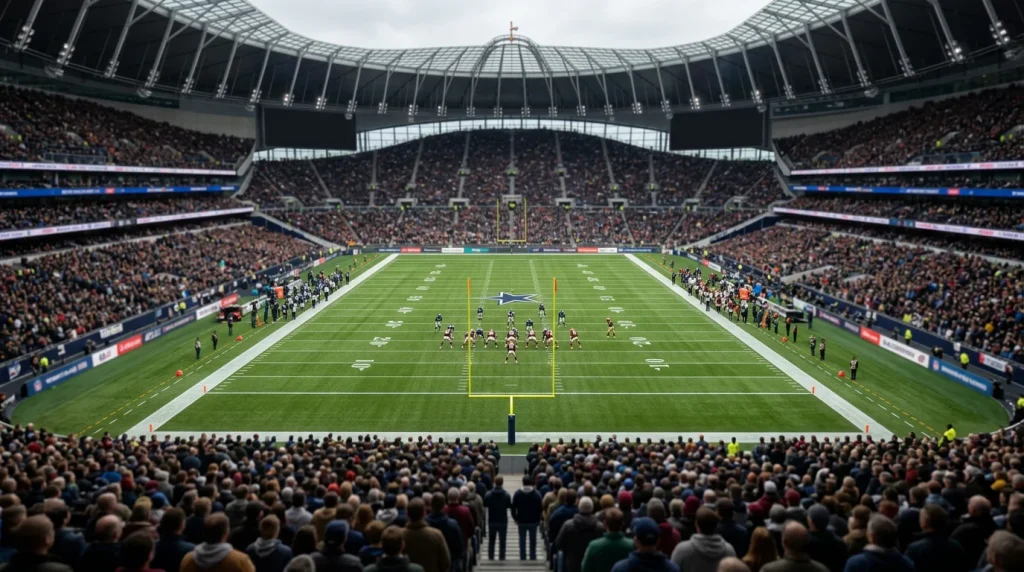
Evaluating Neutral Venue Impact on Team Performance and Spreads
The first NFL game I ever watched in person was a London fixture in 2014. Twickenham, eight degrees, sideways drizzle. The home team — designated home, anyway — had flown in 36 hours earlier and looked it. The visiting team had arrived a day later but had built their travel plan around a Friday acclimatisation session. By the end of the second quarter, the home team’s offensive line was getting beaten on snaps that they would have won at home, and the spread that had opened at the home team minus 3 had drifted live to a pick’em. The lesson I took away that afternoon has never left me: London games are not regular fixtures, and the spread that the market opens with is rarely the spread the conditions deserve by kickoff.
The London games have grown from a curiosity to an annual sub-season. 42 NFL regular-season games have been played in the UK since 2007, attended by more than 3 million fans in total, with a cumulative economic impact in London of over £2 billion. The 2026 schedule contains 9 international games — a record — with 3 in London at Tottenham Hotspur Stadium and Wembley. For UK punters, that is three weeks a year where the headline NFL fixture is being played within a Tube ride of home.
Josh Harris, Managing Partner of the Washington Commanders, framed the appeal of London directly when his team played their London fixture: London is home to some of the most passionate sports fans in the world, and the Commanders are grateful for the opportunity to bring the NFL to a unique city. That passion drives ticket demand far ahead of supply — the 2019 Tottenham game saw tickets oversubscribed by a factor of 12 and sold out within 45 minutes — and the betting market reflects that demand, but not always accurately. This article walks through the fixture history that shapes today’s market, the timing and jet-lag edge that UK punters can exploit, weather and pitch conditions specific to London venues, the markets where London games behave differently, and the FAQs that keep coming in.
How the London fixture series became a permanent sub-season
The first NFL regular-season game in London was the Giants vs Dolphins at Wembley in 2007. Attendance was strong, the broadcast numbers held up, and the league locked in an annual fixture. By the mid-2010s the schedule had expanded to three games per year, then four. The 2026 calendar contains 3 London games out of 9 total international fixtures, the highest London number to date.
The fixtures have rotated through a small set of home teams that volunteered to give up a home game. The Jacksonville Jaguars have been the most frequent volunteer, playing London games almost every year since 2013, and the team has used the recurring fixtures as a marketing lever to build a UK fan base ahead of broader league expansion. Other regular London hosts include the Rams (now relocated to Los Angeles), the Falcons and most recently the Vikings and Bears.
What matters for betting is that the designated home team is the team that lost a home gate to be in London. They are sleeping in a hotel, training at an unfamiliar facility, and managing a six-hour time-zone shift. The visiting team has the same time-zone challenge but the psychological framing is closer to a neutral-site game than to a road game. Pre-game spreads that price the home team as if they had genuine home-field advantage are pricing a fiction. The most efficient UK books have caught up to this and now price London fixtures closer to neutral-site lines, but smaller books and the early-week openers occasionally still post home-team lines that fade quickly as Saturday approaches.
The afternoon kickoff times at Wembley create the perfect environment for NFL live in-play betting without staying up all night.
Kickoff time and the jet-lag edge that UK punters can read
London kickoffs happen between 14:30 and 18:00 UK time, which is 09:30 to 13:00 US Eastern Time. That is morning football for American players. NFL players are not used to playing morning games, and the data over the London fixture history shows a slight performance drop relative to the same teams’ afternoon and evening home performances.
The jet-lag effect compounds the morning-kickoff effect for the designated home team specifically. Even with full charter logistics, a team flying east to a six-hour time-zone difference and playing within 72 hours of arrival is operating against circadian rhythms that have not adjusted. Players report worse sleep quality, slower reaction times in the first quarter, and quicker fatigue late. The visiting team faces the same time-zone shift but arrives with a slightly different psychological context — the road-trip framing, the team-bonding effect of an international road game — that data suggests partly offsets the physical disadvantage.
UK punters can read these dynamics in real time in ways that US punters cannot. Practice reports from London hotels make local news. Friday training-session details leak to UK sports media. Saturday weather forecasts for the specific London venue are easier to assess from inside the country than from the US East Coast. The information advantage is small but real, and it tends to favour the visiting team in tight spreads, particularly when the visiting team has experience with London fixtures.
One specific tell to watch: the offensive line of the home team in the first quarter. Tired offensive lines lose snaps at the line of scrimmage, and the first quarter is when the time-zone fatigue is most visible. If the live spread has not moved meaningfully off the pre-game number after a slow first quarter from the home team, the live spread on the visitor is often a better number than the pre-game offered.
Weather and pitch conditions at London venues
London weather in October and November is unstable in ways that affect NFL games more than the typical American venue. Wind off the Thames basin can gust unexpectedly. Rain is a regular feature. Pitch conditions at Tottenham Hotspur Stadium are excellent — the venue was built with NFL in mind and the surface is one of the best of any international fixture venue — but Wembley pitches have historically deteriorated during football-heavy autumn schedules, with NFL games sometimes played on surfaces that have hosted three or four football fixtures in the preceding fortnight.
The weather effect on totals is the same as at outdoor US venues. Wind above 15 mph drops a typical game total by 1.5 to 3 points. Persistent rain compresses passing efficiency. Cold below freezing — rare in early autumn London but possible by late November — adds another notch of compression on offensive output. UK punters watching the forecast in real time often have a 24-hour lead on US punters who are looking at a generic London weather projection from across the Atlantic.
Pitch quality is the variable US punters tend to ignore. A Wembley pitch that has just hosted a midweek football fixture can absorb late-week rain in patterns that affect kicking lanes and offensive footing. The kicker totals market — over/under on field goals made — is the prop most directly affected by pitch quality, and it is the prop that the larger UK books tend to under-shade for London games relative to the actual pitch conditions on the day.
Get the latest injury reports and travel updates directly from NFL Betting Help.
The markets where London games behave differently
Three markets behave noticeably differently for London fixtures compared to typical NFL fixtures. The first is the game total. London games have historically gone under the posted total at a higher rate than NFL games as a whole, driven by the combination of morning kickoff, jet-lag fatigue, and the often-difficult weather. The under-bias is not large enough to be a blind strategy, but it is a meaningful tilt that punters should incorporate into their totals analysis on these games.
The second is the home-team moneyline. The designated home team in London games is, as noted above, not playing a true home game. Pre-game moneylines that price them as a home favourite at a discount typical of a 3-point home-field advantage are often mispriced. The market has tightened on this over the last several seasons, but early-week London lines from smaller UK books are sometimes worth a check before the line steam catches up.
The third is the first-quarter total. London games have shown a marked tendency to start slowly in the first quarter — both teams adjusting to the conditions, the unfamiliar venue, the early kickoff — and then accelerate in the second half. First-quarter total markets that price the opening 15 minutes at the same per-quarter rate as a typical NFL game often overstate the expected scoring, leaving the first-quarter under as a small but consistent edge.
Conversely, the second-half total markets sometimes underprice the second-half scoring. By the third quarter, both teams have adjusted to the conditions, the jet lag has dissipated for the visiting team, and the offensive playbooks open up. Second-half overs on London games are the corresponding edge to first-quarter unders. The two combined — first-quarter under, second-half over — are a same-game position that requires careful sizing, because they are partially anti-correlated and a bet builder structure would price them less favourably than independent placement.
The weather and conditions side of London game betting deserves its own deeper treatment, particularly the wind dynamics at Tottenham and Wembley which differ in ways that experienced UK punters can read more accurately than US-focused sources — see how NFL weather impacts betting lines for the systematic framework on which kicker, total and passing-yardage markets respond to outdoor conditions.
Do NFL London games have different totals lines than typical NFL games?
Slightly, yes. London game totals at major UK sportsbooks are typically posted 1 to 2 points lower than the same teams would attract for a comparable home game, reflecting the historical under-bias driven by morning kickoff, jet-lag fatigue and frequent outdoor weather effects at Tottenham and Wembley. The adjustment is built in at the line setting stage but tends to under-correct, leaving room for unders to remain a small directional edge.
Why are the Jacksonville Jaguars such frequent London fixtures?
The Jaguars have used the recurring London fixtures since 2013 as a long-term UK market-building project, giving up a home game most years in exchange for the international exposure. The franchise has built one of the strongest UK fan bases of any NFL team through this strategy, and the league has reinforced the arrangement by routinely scheduling the Jaguars as the designated home team for one of the three annual London games.
Articles
Prepared by the NLF Betting Help editorial staff.
