
NFL Moneyline Betting: Outright Winners and Implied Probability
 Available in US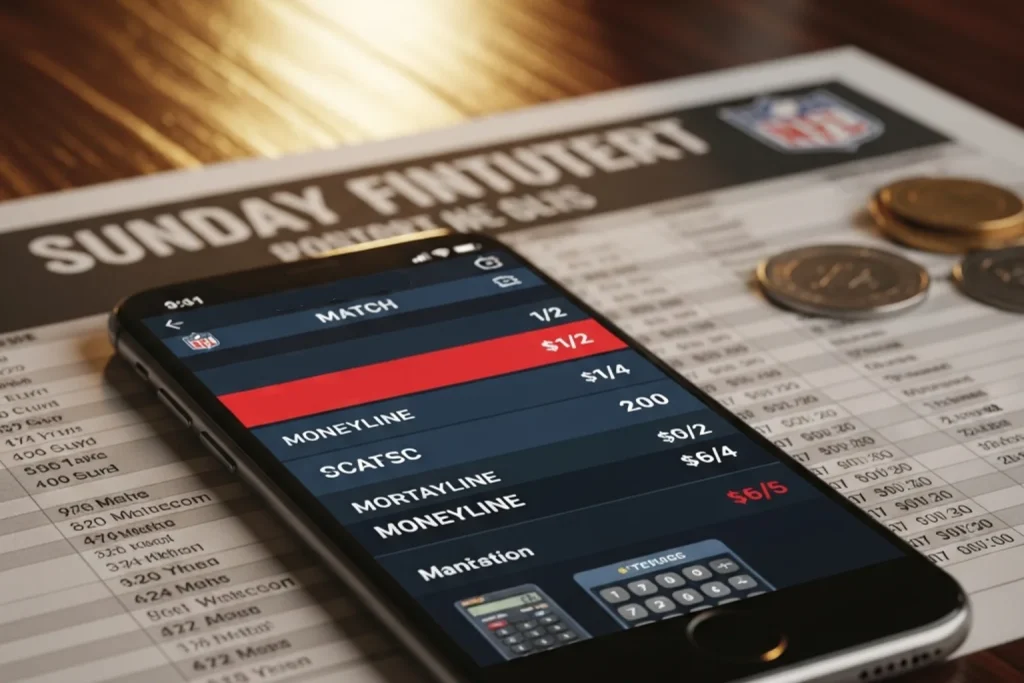
Mispriced Moneylines: Identifying Value in Outright Odds
The first NFL bet I ever placed, back in 2017, was a moneyline on the Patriots. I assumed I was getting good value. I was not. Nine years and several thousand UK punters’ questions later, I can tell you the moneyline is the bet that beginners pick because it looks straightforward, and then quietly lose on because they never learn what the price is actually telling them.
The data backs this up. Across the latest consumer surveys, 52% of NFL bettors say they use the moneyline market, while 61% use the point spread and 47% use totals. Moneyline punters outnumber totals punters, yet most of them couldn’t explain why a Chiefs price at 1/2 represents an implied probability of 66.7%. That gap — between picking the bet and understanding the bet — is the entire reason this article exists.
Here is what I want you to walk away with: a moneyline is a price, not a prediction. The sportsbook is not telling you who will win. It is telling you how much it costs to bet on each outcome after the book’s margin has been baked in. Once you internalise that distinction, every other decision about when to use the moneyline gets easier. We’ll go through the mechanics, the maths, the trap, and then a worked example in £ and UK fractional odds so you can see it land.
What a moneyline bet actually is
A punter on OLBG asked me last winter whether “moneyline” and “winner” were two different markets. They are not. The terminology shifts because UK sportsbooks inherited the bet from American books, where it has always been called the moneyline, and some UK operators rebrand it as “match winner” or “to win” while leaving the pricing identical. If you see “moneyline” on bet365 and “winner” on Sky Bet for the same Chiefs–Bills fixture, the underlying wager is the same: pick which team wins, no handicap, no margin of victory, no overtime asterisks beyond the standard “result after overtime stands” rule.
That simplicity is also the bet’s weakness as a value vehicle. Because there is no handicap to level the contest, the sportsbook prices the favourite and the underdog at sharply asymmetric numbers. A 7-point home favourite might trade at 1/3 on the moneyline — risk £3 to win £1 — while the underdog sits at 11/4, risking £1 to win £2.75. The shape of those numbers is not about the book’s opinion of the game. It is about the implied probability the market is asking you to beat.
What the moneyline is not: a tie market, an over/under, or a handicap. NFL games rarely end in a tie — fewer than one tie a season on average across the modern era — and most UK books push moneylines back as a stake refund if the rare tie occurs, while a few offer a three-way moneyline with a separate “tie” price. Read the small print on tie settlement before you stake; it is the single quietest source of confusion among new punters.
How sportsbooks build a moneyline price
I once spent an afternoon with a trader at a UK book during a quiet midweek slot, watching how a Thursday Night Football line was managed. The takeaway: the moneyline you see is not the trader’s “true” probability. It is the trader’s true probability plus a margin, then shaded for expected money flow.
Start with the maths. If a trader believes the home favourite has a 65% true chance of winning, the fair moneyline in decimal is 1/0.65 = 1.538, which in fractional is roughly 8/15 or 4/7. But the book will not list 8/15. The book will list something like 1/2, which equates to a decimal of 1.50 and an implied probability of 66.7%. That extra 1.7 percentage points of implied probability is the overround — the book’s margin on that side. The underdog gets the same treatment. Together, the two sides add up to roughly 104–106% in implied probability, with the surplus over 100% being the total overround.
Shading is the second layer. UK bookmakers know recreational punters love favourites and especially love high-profile favourites. So a Chiefs moneyline against a small-market underdog will often be a sliver of a tick worse than the maths alone would justify, because the trader knows public money will pile in regardless. If you only ever bet favourites at the biggest UK retail brands, you are paying for that shading on top of the overround. That is not a moral judgement — it is just the structure of the market.
Line movement on the moneyline tells you something useful: where the sharp money sits. If a line drifts from 1/2 to 4/9 over the four days before kickoff, the book is shortening the favourite because either professional money or significant volume has come in on that side. Drift the other way, and the favourite is being faded by people the book respects. Watching that movement, rather than reacting to it, is one of the cheapest forms of research available to a UK punter.
Reading the price as implied probability
Here is the conversion every UK punter should be able to do in their head within a few seconds of seeing a fractional price.
For fractional odds X/Y, the decimal price is (X/Y) + 1, and the implied probability is 1 / decimal price, expressed as a percentage. Chiefs at 1/2 gives you decimal 1.50 and implied probability 66.7%. Bills at 7/4 gives you decimal 2.75 and implied probability 36.4%. Add them: 103.1%. The 3.1% over 100% is the overround on that two-way market.
The implied probability is the threshold your own estimate has to beat for the bet to have value. If you watch the tape, run the numbers and believe Chiefs win 70% of the time in that matchup, the 66.7% implied at 1/2 is below your estimate, and the bet has theoretical value. If you think Chiefs win 60%, the 66.7% is above your estimate, and the bet has negative expected value before you even count the overround. Most recreational punters never run this comparison — they bet because the team is good, the colours are nice, or the trader on YouTube said so.
The lesson I keep repeating to people who message me about losing streaks: you are not betting on the team, you are betting on the price relative to the true probability. The moneyline is the cleanest place to learn this discipline because there are no spreads or totals to confuse the comparison.
When the moneyline is the right tool
For a stretch in 2021, I tracked every NFL bet I placed and split them by market. The moneyline outperformed my spread bets in two specific situations, and only those two.
First, with mid-priced underdogs in the 2/1 to 4/1 range. The point spread on a 7-point underdog usually trades around evens with juice — risk £100 to win £91. The moneyline on the same underdog might pay 9/4 or 11/4, which means you only need to be right about 30–35% of the time to break even, and the variance of being right on outright winners is more forgiving for small bankrolls than the variance of getting the spread cover within a couple of points.
Second, with divisional matchups where the spread has been chewed up by familiarity. In an NFC East rematch between teams that played four weeks earlier, the spread might be artificially tight because the book is reacting to the prior result. The moneyline on the slight underdog can carry more value because the public is still biased by the earlier scoreline, while the price more honestly reflects the matchup.
Where the moneyline becomes a trap is on heavy favourites. Chiefs at 1/5 means you risk £5 to win £1, and you need the favourite to win 83.4% of the time just to break even. Across a full NFL season, even a side that wins 80% of its games will leave you negative if you bet them at 1/5 every week. The maths is brutal, and the fact that it feels safe is the precise reason it isn’t.
A worked moneyline example in £ and fractional
Let’s run a real-world fixture shape. Imagine a Sunday afternoon UK time game: Chiefs at home against Jets. The UK fractional prices on the moneyline at a typical major book are Chiefs 1/2, Jets 6/4. Decimal equivalents are 1.50 and 2.50. Implied probabilities are 66.7% and 40.0%, summing to 106.7%, so the overround on the two-way market is 6.7%.
Stake £10 on Chiefs at 1/2. Profit if they win is £10 × (1/2) = £5. Total return is your £10 stake back plus £5 profit, so £15 hits your account. Stake £10 on Jets at 6/4. Profit if they win is £10 × (6/4) = £15. Total return is £25, with £15 of that being profit.
Now compare to what you would have made on the same fixture priced fairly without the overround. If true probabilities were 65% and 35%, fair fractional on Chiefs would be roughly 11/20 — a profit of £5.50 on a £10 stake — and Jets fair fractional would be 13/7, a profit of about £18.57. The £0.50 you lose on Chiefs and the £3.57 you lose on Jets are the book’s margin showing up in your pocket. Multiply that across a season of 50 bets and the overround compounds into a meaningful drag on returns. Line shopping across UK books, where overrounds vary by half a percent to a full percent between operators, is how recreational punters claw a chunk of that back. The next step up from understanding the moneyline is understanding the handicap that sits next to it on every match page — see how NFL point spread betting works in the UK for the detailed mechanics.
What"s the difference between a moneyline bet and a "winner" market?
None. Some UK sportsbooks label the same two-way win bet as the moneyline, others as match winner or simply to win. The pricing, the settlement rules and the overround are identical. The label change is purely a UK branding choice; the underlying wager pays out the same way.
Is the NFL moneyline always priced at minus 110?
No. Minus 110 is American shorthand for roughly 10/11 fractional, which is the standard juice on a point spread, not a moneyline. The moneyline has no built-in handicap, so favourites and underdogs are priced at sharply different numbers. A Chiefs moneyline might trade at 1/3 fractional while the Jets price on the same fixture sits at 5/2.
Why do NFL moneyline favourites pay so little?
Because the implied probability on a heavy favourite is high. A 1/5 fractional price equates to about 83% implied probability, meaning you only profit if the favourite wins more often than 83% of the time across enough bets to outpace variance. Most NFL favourites do not clear that bar after the book"s overround is baked in.
Articles
Written by the editors at NLF Betting Help.
