
NFL Live In-Play Betting: Timing UK Markets and Halftime Edges
 Available in US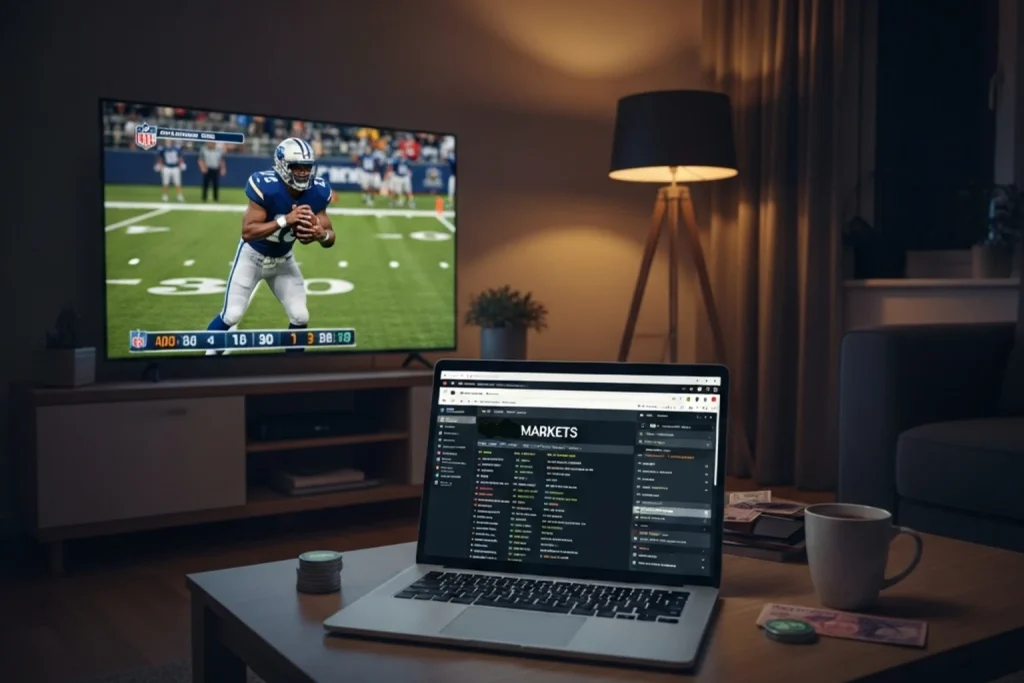
Exploiting the Atlantic Time Gap for Favorable Live Odds
On a Sunday in late October, I was watching the early kickoff at home in London, phone in one hand, laptop in the other. The Bills were a 4-point favourite, ten minutes into the second quarter, and they had just turned the ball over inside their own 30. The pre-game spread had moved to Bills −2.5 live. I had finished dinner, had a cup of coffee in front of me, and had spent the last hour reading injury notes from the previous evening’s inactives list. The friend I was texting in Pittsburgh was just waking up to start his Sunday. The gap between those two states — calm UK evening vs scrambled US morning — is the single most underrated advantage in NFL betting for a UK punter.
That advantage is structural and growing. Sky Sports signed a new three-year deal in August 2025 running through 2027, giving the broadcaster exclusive first pick of the 18:00 UK kickoff and the 21:00 UK kickoff, increasing live NFL broadcast volume by about 50% over the previous deal. Channel 5 returned NFL to free-to-air British TV in the 2025 season for the first time in 20 years. The result is more live games available to UK eyes than at any point in the sport’s UK history, and the evening kickoff timing puts those games in the prime research window for a recreational punter.
Bryan Henderson, Director of NFL at Sky Sports, framed the trajectory neatly: the figures are testament to the continual growth of the NFL in the UK and Sky is extremely proud to play a role in helping its expansion into new audiences. That growth is the backdrop for the live betting market. More punters, more volume, deeper liquidity on in-play prices than the UK NFL market has ever carried before.
This article walks through how live NFL markets actually update, why the UK evening kickoff is an information advantage, the halftime and fourth-quarter windows where the market is most readable, the live prop and drive-by-drive markets, and the questions UK punters ask me most about the mechanics.
How live NFL markets actually update
Live NFL pricing at a UK book is a feedback loop between three inputs: the official play-by-play data feed from the NFL, the book’s own win-probability model, and the running tally of money coming in on each side. The feed updates every play. The model recalculates the implied probabilities for the remaining markets — moneyline, spread, total, live props — and the trader either accepts the model output or applies a manual adjustment if the volume is heavily one-sided.
Refresh speed varies. The faster UK books update visible odds within 5 to 10 seconds of a play ending. The slower ones lag closer to 20 seconds. That window is meaningful, because punters watching the broadcast in real time can sometimes see a market price that has not yet caught up with the play just shown on screen. Those gaps close fast — usually within one or two snaps — but they are the cleanest tactical windows in live betting.
Markets lock occasionally. When the play is unusual — a turnover, a long touchdown, an injury timeout — the book pauses pricing while the trader and the model reconcile. The visible odds disappear or grey out, and any bet you try to place gets rejected or held for manual review. A lock typically lasts 10 to 60 seconds. The longer the lock, the more significant the event the book is repricing around. Frequent locking on a single fixture usually signals high volatility or a thin market where the book is being cautious.
The third dynamic worth knowing: live markets have wider overrounds than pre-game markets. A pre-game spread might carry a 4.5% overround. The same spread, refreshed live in the third quarter, often carries 6 to 8%. The book is paying for the variance of pricing a moving target, and you pay for the convenience of placing the bet during the game.
Why the UK evening kickoff window is an advantage
NFL Sunday kicks off at 18:00 UK time for the early window and 21:00 UK time for the late window. That schedule lines up almost perfectly with the period after a typical UK punter has finished work, eaten, and sat down with a screen. By the time the late window kicks off, a UK punter has already had three hours to digest the early games, watch the live odds movement, and refine any pre-game research with what the actual broadcast has shown.
Compare that to a US punter on the East Coast. The early window kicks off at 13:00 local time, mid-Sunday. The late window kicks off at 16:00 local time. A US punter is juggling betting decisions with everything else a Sunday demands — family, errands, NFL Red Zone on a second screen — and the live market reflects that volume. UK punters can read live lines in a calmer state with more concentrated attention.
The information layer compounds this. UK Sky Sports coverage shows the same broadcast feed as the US viewer gets, but the studio analysis is filtered through UK presenters who have processed the storylines through the week. Channel 5’s free-to-air coverage is a less detailed broadcast but reaches a wider UK audience, which feeds back into the volume on UK books. The result is a market with more liquidity and tighter pricing on the headline games, and softer pricing on the games that have less UK broadcast attention.
The practical takeaway is to know where the live market is sharpest and where it is softest. Headline games — Chiefs, Bills, Cowboys, anything featuring a marquee QB — see tight live pricing with little tactical opportunity. The mid-card games, particularly Sunday afternoon US matchups that hit 18:00 UK time, often carry softer live lines because the UK volume is lighter. That is where the UK evening advantage actually pays.
The halftime and fourth-quarter windows
Halftime is the most readable period in live NFL betting. The game has produced two quarters of actual data — pace, possession, scoring efficiency, injury exits — and the book has 15 minutes to reprice the second-half markets. Those second-half lines are usually posted within five minutes of the halftime whistle and are typically the sharpest live lines of the entire game. The first 20 minutes of halftime are the window when the line is most efficient and the punter has the most time to think.
What the halftime market gives a punter who has done their pre-game research is a chance to express a view on game script rather than the headline outcome. If your pre-game view was “Chiefs win, but it’s a slow grind”, and the first half confirms that — Chiefs leading 13–7, three combined turnovers, sub-50% conversion rates — the second-half total under is a cleaner bet than chasing the live moneyline. The book has built that game script into the second-half number, but rarely with the same precision as a pre-game total that has had three days to mature.
The fourth quarter is where live betting becomes most reactive and least patient. A one-score game in the fourth quarter sees live lines move every play, sometimes by 2 to 3 points on the spread for a single significant down. The volume is concentrated, the spreads are wider, and the variance per bet is highest. I have made more mistakes betting the fourth quarter live than at any other point in any game, and the lesson is the same every time: if your pre-game read no longer applies, the answer is to stop, not to scramble.
Live props and drive markets
Beyond the moneyline, spread and total, UK books offer live prop markets that update through the game. Next-score markets ask whether the next score will be a touchdown, field goal or safety, and which team will score it. Drive markets ask what will happen on the current possession — touchdown, field goal, turnover, punt, end of half. Player props refresh live with adjusted lines: a WR’s receiving yards line drops if he has already exited with injury, climbs if he has been targeted heavily early.
The drive markets are short-lifecycle bets, settled within one possession. The book prices them off recent drive efficiency, field position and time remaining, and the overround per market is high because each drive carries significant variance. They are entertaining and the worst form of bankroll discipline available on any UK book. I do not place drive bets myself for that reason. If you choose to, treat each one as a small entertainment stake — well under your standard prop unit — and accept that the book’s margin on these markets is closer to 10% than to 5%.
Live props are a better proposition. The lines are recalibrated less frequently than drive markets and the book’s margin is lower. A live WR receiving yards line that has been adjusted at halftime is often the most edge-friendly prop market on the entire match page, because the book is essentially reissuing the prop with new information and the broader market has not yet caught up. The flip side of any in-play bet, particularly multi-leg in-play bets, is the cash-out temptation that the book builds directly into the app — and the maths behind that temptation is its own rabbit hole, covered in how UK sportsbooks build cash-out prices on NFL bets.
How quickly do live NFL odds refresh in UK sportsbooks?
The faster UK books refresh live odds within 5 to 10 seconds of a play ending. The slower ones lag closer to 20 seconds. Refresh speed depends on the operator"s data feed and pricing infrastructure, and the gap between fast and slow books occasionally creates short windows where a price has not caught up with the play just shown on the broadcast.
Why do live NFL moneyline prices sometimes lock during a game?
Locks happen when an unusual play — a turnover, a long touchdown, an injury timeout, a successful or failed two-point conversion — triggers the book"s trader and pricing model to reconcile a new game state. The visible odds disappear briefly while the new price is calculated. Locks last anywhere from 10 to 60 seconds, with longer locks signalling more significant repricing events.
Is live NFL betting easier than pre-game betting?
Easier is not the right word. Live betting offers different information than pre-game betting — actual play data instead of projection — but carries wider overrounds and more emotional pressure. Punters who do disciplined pre-game research and use the live market to refine that research can find edge. Punters who use live betting as a substitute for research usually pay a higher margin for worse outcomes.
Articles
Created by the "NLF Betting Help" editorial team.
