
NFL Cash Out Mechanics: Pricing, Algorithms and Bet Buyouts
 Available in US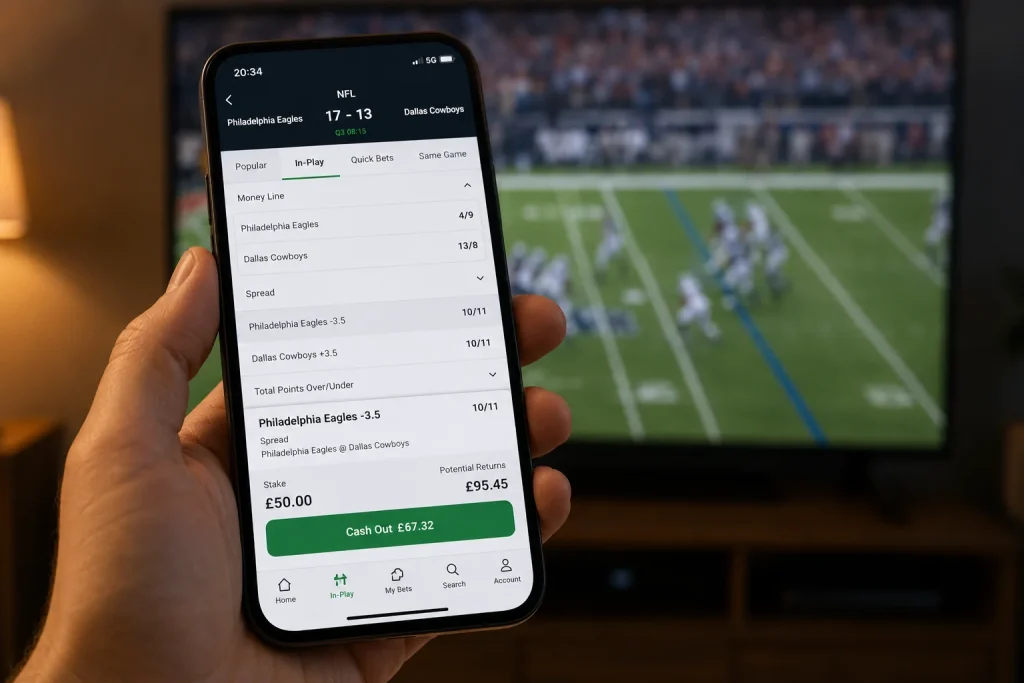
The Mathematics Behind Bookmaker Cash Out Offers
The most useful thing I can tell a UK punter about cash-out is also the least flattering: across a season of data, the button costs you money far more often than it saves you any. The marketing positions it as control — your bet, your choice, lock in the win — and on a single slip in a single moment, it can be exactly that. The problem is that the cumulative pattern of cash-out decisions across hundreds of slips reliably underperforms simply letting the bets ride. The book builds the cash-out price to make sure of it.
Cash-out availability has grown sharply alongside live betting. Sky Sports signed a new three-year deal in August 2025 that increased live NFL broadcast volume by roughly 50% — which directly expanded the window in which cash-out is offered on live NFL slips at every major UK book. The point spread, the most popular NFL market at 61% of bettors, is also the market on which cash-out is most aggressively pushed, because the binary spread settlement is the easiest outcome for the book’s pricing model to track in real time.
This article walks through how the cash-out price is actually built, what partial cash-out is doing under the hood, the cash-out versus let-it-ride decision in the cases that matter, the difference between live and pre-game cash-out, and the FAQs I get most often from UK punters trying to decide whether to press the button.
How a UK sportsbook builds the cash-out number
The cash-out price you see on a slip is built from three numbers: the current implied probability that your bet still wins, the original stake amount, and a margin layer that the book charges for the service of letting you exit early. The maths underneath is straightforward; the part the punter rarely sees is the size of that margin layer.
Start with a pre-game spread example. You staked £20 on Chiefs −3.5 at 10/11 fractional. Your projected total return if the bet wins is £38.18. The Chiefs are leading by 10 at halftime. The book’s live model now estimates the probability that Chiefs cover −3.5 at the final whistle as 78%. The fair cash-out price, ignoring margin, is 78% of £38.18 = £29.78. What the book actually offers you is closer to £28.30. That £1.48 gap is the cash-out margin — typically 3 to 6% on top of the fair price, occasionally higher on volatile live spots.
The margin compounds with each cash-out you accept. A punter who routinely cashes out at the halftime favourable position is paying that 3 to 6% margin on every slip on top of the original 4.5% spread overround. Across a season, that combined drag turns a marginally winning strategy into a marginally losing one. The cash-out price is not a free service. It is a paid convenience.
One additional dynamic: cash-out values are most generous immediately after a positive event — a turnover, a big play — and tighten quickly as the book’s model catches up. If you are going to take cash-out at all, the 30 seconds after a positive event is the window where the offer is closest to fair. Wait three minutes and the book’s model has re-priced and the offer is back to the standard margin spread.
What partial cash-out actually does
Partial cash-out is the feature where you take some of the cash-out value now and let the remaining stake run. The slip splits into two pieces: the cashed-out portion settles immediately, and a smaller residual stake continues to the original outcome.
Run the maths on the same example. £20 on Chiefs −3.5 at 10/11, projected return £38.18 if it wins. The full cash-out offer is £28.30. The partial cash-out interface lets you take, say, £14.15 now and leave the equivalent of £10 of stake riding on the original price. The cashed portion is locked, the residual portion continues to settle as a £10 win-or-lose bet at the original 10/11 fractional.
The structural problem with partial cash-out is that the book applies the same margin layer to the cashed portion as to a full cash-out. You are not getting a discount for cashing only half — you are paying the same 3 to 6% margin on the cashed amount, while accepting a smaller residual at the original price. The total expected return after a partial cash-out is mathematically very close to a full cash-out scaled to the same proportion. Partial cash-out is the same product priced the same way, just split into a different shape on the slip.
Where partial cash-out can be defensible is the same place full cash-out is defensible: when you have material new information that the book has not priced in. If a key player exits with injury between the time the partial offer appears and the time the book locks the market, taking the partial cash-out before the market re-prices is a defensible play. In every other scenario, partial cash-out is psychological comfort dressed up as risk management.
Cash out versus letting it ride — the decision that actually matters
The cleanest framework I have found for the cash-out decision is to ignore the offer entirely and ask one question: at the cash-out value being offered, would I re-stake that amount on this exact bet at this exact line if it were a fresh wager?
Take the Chiefs example again. You staked £20 on −3.5 pre-game. The Chiefs are up 10 at halftime. The book offers £28.30 cash-out. If you reframe that as a fresh bet, you are being asked: would you stake £28.30 right now on Chiefs −3.5 to win £9.88 (the difference between £28.30 and the £38.18 final return)? At an implied probability of 74% — the book’s view minus the margin — that is the question.
If you would not place that fresh wager — if 74% seems too low for the Chiefs to hang onto the cover, given the second-half scheduling, the injuries, the game script — then taking the cash-out is the right call. The math has flipped against your original view and the lower locked-in return is better than the negative expected value of letting it ride.
If you would happily place that fresh wager — if your view is that 74% under-states the Chiefs’ chance to cover — then letting it ride is the right call. The cash-out is offering you a discount on a position you would willingly take at the going price, and accepting the discount means giving up positive expected value.
Compare.bet’s UK beginner guide is clear on the broader principle: no-one said betting on the NFL was easy or that turning over a long-term profit was par for the course. The cash-out decision is one of the cleanest tests of that discipline, because the book has dressed up a margin charge as a courtesy and the punter has to keep both halves of that transaction in mind to make the right call.
Live cash-out versus pre-game cash-out
Pre-game cash-out is offered on a bet placed before kickoff, with the option to cash out at any point until the bet’s settlement event. Live cash-out is offered on a bet placed during the game itself. The mechanics of the cash-out calculation are identical in both cases — implied probability times projected return, minus the margin layer — but the volatility profile is very different.
A pre-game bet entering its live window typically gets cash-out offers that move with the live odds. The margin layer is consistent across the game’s duration, but the underlying implied probability swings sharply as the game progresses. A spread bet that looked likely at the start of the third quarter can look very different by the start of the fourth, and the cash-out offer reflects that swing.
A live bet placed during the game enters its cash-out window almost immediately. The book’s margin layer on live cash-out is wider than on pre-game cash-out — typically 5 to 8% versus 3 to 6% — because the book is pricing a moving target with less stable model output. Cashing out a live bet within minutes of placing it almost always returns less than the original stake, because you are paying two margin layers back-to-back: the live bet’s overround and the cash-out margin.
The practical guidance is to treat cash-out as a feature that applies to pre-game bets in their live window, not to live bets at all. Live bets should be placed with the intent to let them settle. If you find yourself routinely placing live bets and immediately reaching for the cash-out option, the issue is not the cash-out mechanic — it is the bet selection process upstream.
A worked cash-out example with the maths in view
Sunday evening. You staked £15 pre-game on the Bills moneyline at 5/6 fractional (decimal 1.83). Projected total return if Bills win: £27.50. Bills are leading 17–10 at the start of the fourth quarter. The book’s live model implies a 72% chance the Bills hold on for the win.
Fair cash-out value: 72% × £27.50 = £19.80. The book offers £18.75. The cash-out margin in this offer is £1.05, or roughly 5.3% of the fair value.
Apply the framework. Would you, fresh, stake £18.75 on Bills to win in the next 15 minutes of game time, at an implied probability of 68% (£18.75 ÷ £27.50)? If yes — if you trust the Bills to hold the lead against this defence in this situation — then let it ride. If no — if you think 68% over-states their chance given a tired defence, a Bills offensive line dealing with injuries, or a hostile late-game environment — then take the £18.75 and book the win. The book is not telling you what to do. The cash-out offer is just framing the question. Where the punter genuinely controls the live exit decision is on the betting exchanges, where the same logic applies but without the cash-out margin layer because you are trading directly against another punter — see how NFL betting exchanges in the UK actually work for the structural alternative to sportsbook cash-out pricing.
Can the sportsbook refuse to offer cash out on an NFL bet?
Yes. Cash-out is a discretionary feature, not a contractual right. UK sportsbooks routinely suspend cash-out during volatile moments — turnovers, injury timeouts, lengthy reviews — and may decline to offer cash-out at all on certain markets, particularly bet builders with thinly correlated legs and futures with months of remaining variance. The slip will display the cash-out value when available and grey it out or remove the button when not.
Is partial cash out always worse than full cash out?
The two products carry the same margin per pound cashed, so neither is structurally worse than the other on a per-pound basis. Partial cash-out lets you keep some upside exposure while locking in part of the position; full cash-out closes everything at once. The right choice depends on whether your remaining view supports continued exposure at the original price — if yes, partial keeps the upside; if no, full closes the negative expected value.
Articles
Created by the "NLF Betting Help" editorial team.
