
NFL Bankroll Management and Unit Sizing for UK Punters
 Available in US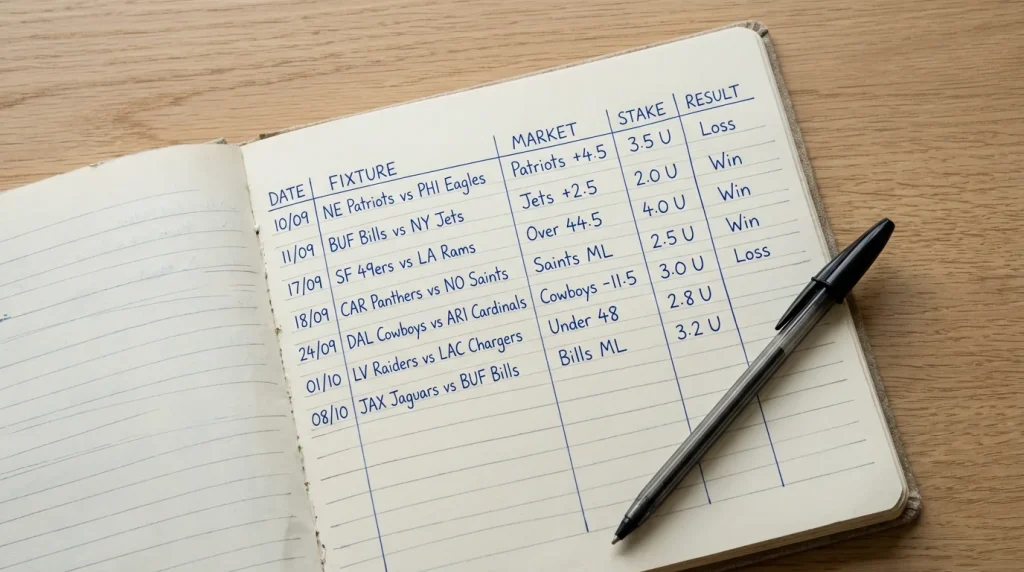
The Sunday I bet 18% of my bankroll on one play
Eight years ago I had a £400 bankroll at the start of my second NFL season. The first Sunday of the season I saw what I thought was an obvious mispriced spread and bet £75 on it. It lost. That was 18.75% of my bankroll on a single play. Two weeks later, with the bankroll down to £290, I saw another obvious spot and bet £60 — 20.7% of what was left. That also lost. By Week 4 I was down to £200 and starting to make worse decisions, because the bankroll was small enough that every bet felt like it mattered too much. I rebuilt over the rest of the season and finished marginally up, but the first six weeks had eroded any margin for error. The fix, which I implemented in Week 5 of that year and have stuck with ever since, was fixed unit sizing — 1.5% of the starting bankroll per bet, recalibrated quarterly, never adjusted for the heat of the moment. Roughly 63% of UK punters bet weekly, and 82% bet regardless of their team’s form, which means the volume of bets placed by the typical UK NFL punter is high enough that unit sizing matters more than almost any other discipline. UK sports betting overall sits at around £2.48 billion in annual gross gambling yield, and the average sustainable return for a careful punter is in the low single-digit percentage of staked volume per year. That is the scale at which bankroll discipline operates.
This guide walks through how to define an NFL bankroll, the difference between fixed-unit and proportional staking, the Kelly Criterion and where it actually fits, and the tracking discipline that makes any of it real.
Defining the NFL bankroll
The bankroll is the amount of money you have allocated specifically to NFL betting for the season. It is not your sportsbook balance, which fluctuates with deposits and withdrawals. It is not your disposable income. It is the figure you have decided to put aside for this purpose, separate from rent, bills, savings and anything else.
The right size of the bankroll depends entirely on personal circumstances and tolerance for variance. The wrong size in both directions is common. A bankroll too small forces unit sizes that are not worth the analytical effort — betting £5 units on a £200 bankroll means even a great season produces £40 to £60 of profit, which is below the value of the time spent analysing games. A bankroll too large produces unit sizes that exceed the punter’s tolerance for variance, and the emotional decisions that come from over-staking erode any edge the underlying strategy might produce.
I would suggest defining the bankroll in three steps. First, identify the figure you would be entirely unbothered by losing over a season — not the maximum you could afford to lose, but the figure where a total loss would not affect any other part of your life. Second, divide that figure by 100 to get a starting unit size. Third, check that the unit size is large enough to be worth your analytical time but small enough that no single bet would change your mood. If the unit size from the second step does not pass the third step, the underlying bankroll needs to be revisited.
The right figure varies enormously between punters. Someone with £40,000 of disposable income per year might land on a £4,000 bankroll and £40 units. Someone with £8,000 might land on a £400 bankroll and £4 units. The proportions are the same; the absolute figures depend on the punter’s circumstances. There is no universally correct number.
Fixed unit staking: the discipline that works
Fixed unit staking is the practice of betting the same nominal amount on every bet for a defined period — typically a quarter of the season or the full season — regardless of recent results, recent confidence levels, or specific bet conviction. A unit of 1.5% of the starting bankroll means a £400 bankroll has a £6 unit and every bet for the period is £6.
The case for fixed units is structural. Variance in NFL betting outcomes is high. A 56% hit rate over 50 bets at -110 is roughly the upper limit of sustainable performance, and that hit rate produces a 5-bet win-loss swing in either direction within normal variance. A punter who increases unit size after a win and decreases after a loss is amplifying the variance — the wins are bigger and the losses are bigger, but the underlying expected value per bet has not changed. A punter who does the opposite — increasing after losses to chase, decreasing after wins to lock in — is doing the same thing with worse psychology.
Compare.bet’s UK NFL betting guide put it bluntly: never wager more than 1-2% of your bankroll on any single play, no matter how confident you feel. That advice is structurally correct because confidence levels are imprecisely calibrated even for experienced punters, and the spread between high-conviction and low-conviction bets is much narrower in actual expected value than it feels at the moment of betting.
The discipline of fixed units does two things. First, it forces the variance to come from the betting strategy rather than from the staking strategy, which lets you actually measure whether the strategy works. Second, it removes the emotional load from each individual bet — the bet is one of fifty for the quarter, not a heroic position on the next sure thing.
Proportional staking and where it goes wrong
Proportional staking is the practice of betting a fixed percentage of the current bankroll on each bet, recalibrated continuously. If the unit is 2% of bankroll, a £400 bankroll bets £8; after a winning £8 bet at -110, the bankroll is £407.27 and the next unit is £8.15.
The theoretical case for proportional staking is that it scales the unit with the underlying capital, which prevents catastrophic loss in a long losing streak and captures upside in a long winning streak. The practical case against it is that the unit changes every bet and the staking decisions become noise around the underlying strategy.
I tried proportional staking for one quarter in 2020. The unit changed bet by bet, the spreadsheet became a chore, and the psychological load of decreasing units after losses produced exactly the chase-bet behaviour I had been trying to avoid. After the quarter I went back to fixed units recalibrated quarterly — a hybrid that captures most of the proportional benefit without the bet-by-bet recalibration. At the end of each quarter I look at the bankroll, set new units at 1.5% of the new figure, and run that unit size for the next quarter regardless of intraday variance.
The quarterly recalibration window is short enough to respond to underlying changes in the bankroll over a season, and long enough to avoid the chase-bet psychology of continuous proportional adjustment. The trade-off is acceptable.
The Kelly Criterion: where it actually fits
The Kelly Criterion is a formula for optimal bet sizing given a known edge and known odds. The formula is: fraction of bankroll to bet = (probability of winning × decimal odds – 1) / (decimal odds – 1). A bet with a 55% win probability at decimal odds of 2.0 gives Kelly = (0.55 × 2.0 – 1) / (2.0 – 1) = 0.10, meaning bet 10% of bankroll.
The mathematical case for Kelly is robust. The formula maximises the long-run growth rate of the bankroll given accurate inputs. The practical case is much narrower because the inputs are never accurate. The edge a punter believes they have on a given bet is almost always overstated. A 55% true probability is hard to estimate within 5% margin of error, and the Kelly fraction is highly sensitive to small errors in the probability input.
Most experienced punters who use Kelly use a fractional Kelly — typically 0.25 Kelly or 0.5 Kelly — to compensate for the inaccuracy of the underlying probability estimate. A 0.25 Kelly fraction on a 10% Kelly bet is 2.5% of bankroll, which is in the same range as standard fixed unit sizing.
The implication is that pure Kelly is too aggressive for almost any real-world punter, and fractional Kelly produces unit sizes that converge with the 1-2% fixed unit recommendation. The structural value of Kelly is conceptual rather than operational — it explains why the right unit size is around 1-2% of bankroll for the typical NFL bettor with a typical edge.
I do not use Kelly directly. I use 1.5% fixed units recalibrated quarterly, which approximates a 0.3 Kelly fraction for a typical 53-54% hit rate at -110. The two are practically identical in practice, and the fixed unit version is simpler to execute under Sunday-afternoon time pressure.
Tracking and the monthly review
The bankroll management framework is only useful if you actually track the bets and review the results. The tracking discipline I run is small: a spreadsheet with date, bet, sportsbook, odds, stake, result and running bankroll. Each row takes 20 seconds to fill in. Over a season I accumulate 50 to 70 rows, which is enough data to see whether the strategy is working.
The monthly review looks at three things. The hit rate by bet type — moneyline, spread, total, props — to identify which categories are profitable and which are not. The average odds at which bets were placed, which tells me whether the line-shopping discipline is capturing value or not. The cumulative return on staked volume, which is the single metric that matters at the bankroll level.
The point of the review is not to celebrate the good months or panic in the bad months. It is to identify whether any of the bet types are persistently unprofitable. A category that has produced negative return over 20 bets is probably not luck; it is probably a strategy issue. The review lets me drop bet types that are not working and concentrate effort on the ones that are.
The expected-value framework that underlies this is the conceptual link between the bet selection and the bankroll outcome, which I cover in detail in my guide to NFL betting expected value and edge. The bankroll discipline and the expected value discipline are two halves of the same skill — picking bets that have positive expected value, then sizing them in a way that lets the expected value actually be captured across variance.
The quarterly cycle that has actually worked for me
My bankroll management cycle is built around the NFL calendar. The starting bankroll is set in August before the season begins. Units are set at 1.5% of that figure. The first quarter runs from Week 1 through Week 8. At the end of Week 8 I recalibrate — new bankroll figure, new unit at 1.5% of the new figure. The second quarter runs from Week 9 through Week 17. End-of-season recalibration. The playoff quarter runs from the Wild Card round through the Super Bowl, with a separately set unit because the playoff sample is smaller and the variance is higher.
The discipline I have built around this is to never adjust unit size mid-quarter regardless of what is happening with the bankroll. If I go on a losing run in October, I bet through Week 8 at the original unit size and recalibrate at the quarter boundary. If I have a winning run, the same. The unit is locked for the quarter. This single rule has saved me more money than any specific bet selection improvement.
NFL betting from the UK is a long-run game. Fixed unit sizing at 1-2% of bankroll, recalibrated quarterly, with disciplined tracking and monthly review, is the framework that has produced that outcome for me. It is not exotic and it is not glamorous, but the strategies that compound across seasons rarely are.
What is a sensible NFL unit size in pounds for a UK punter?
The right unit size is 1-2% of your defined NFL bankroll. The bankroll itself should be sized so that a total seasonal loss would not affect any other part of your finances. A £400 bankroll produces £4 to £8 units. A £4,000 bankroll produces £40 to £80 units. The proportions are the same regardless of the absolute figures; the right absolute figure depends entirely on personal circumstances.
Should I change unit size mid-season?
Not within a quarter. Continuous adjustment of unit size produces chase-bet psychology that erodes the discipline the unit sizing is meant to enforce. Recalibrating at quarter boundaries — every 8 weeks during the regular season, plus a separate playoff unit — captures most of the proportional sizing benefit without the bet-by-bet noise. Within a quarter, the unit is locked regardless of intraday variance.
Articles
Prepared by the NLF Betting Help editorial staff.
