
NFL Line Shopping: Three Worked Examples Across UK Sportsbooks
 Available in US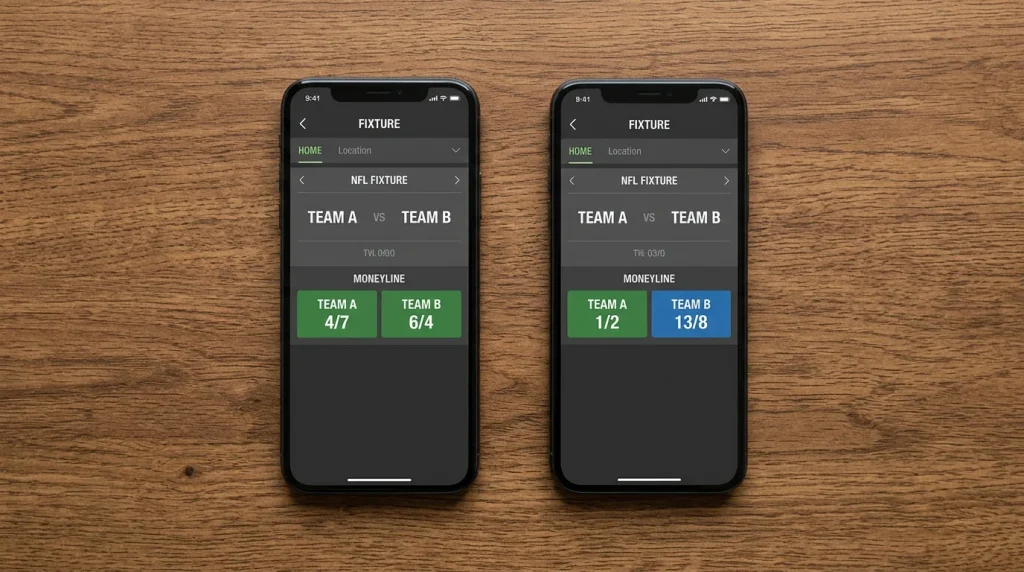
The Tuesday I learnt what 9% commission really costs
The first NFL Sunday of the 2018 season I bet a Sunday-night moneyline at 10/11. I had two accounts open. I checked the first, saw 10/11, and put the bet on. After the bet had settled — winning, as it happened — I noticed that the second book had been offering 5/6 on the same outcome. A £100 stake at 10/11 returns £90.91 in profit. The same stake at 5/6 returns £83.33. The gap was £7.58 on a single bet. Multiply that over a season of 40 to 60 bets and you have a meaningful figure — easily £200 to £400 over the year on equivalent stakes. The betting exchange Matchbook runs at a 2% commission on net winnings — among the lowest commission rates in the UK market — and the structural insight from that figure is the same as from line shopping: even small price improvements compound substantially across volume. This is the cheapest form of edge available to UK NFL punters, and the one I see most punters under-use.
This article walks through three worked examples of line shopping across UK sportsbooks: a moneyline shopping example, a spread half-point example, and a prop line disagreement that produces a structural opportunity. Then I will quantify what the discipline actually saves you across a full NFL season.
Example 1: Moneyline shopping on a Sunday slate
The matchup is a road favourite priced as a 4-point favourite on the spread. The moneyline on the favourite typically prices at around -180 to -200 depending on the specifics. Let us look at how the same moneyline can vary across three UK sportsbooks on a Tuesday morning opener.
Book A opens the favourite at 4/9 (-225). Book B opens at 2/5 (-250). Book C opens at 1/2 (-200). The three implied probabilities are 69.2%, 71.4% and 66.7%. The same outcome, three different prices, three different implied probabilities — a 4.7-point spread between the highest and lowest implied probability.
A £100 stake at 4/9 returns £44 profit. At 2/5 it returns £40 profit. At 1/2 it returns £50 profit. The gap between betting the worst price and the best price is £10 per £100 staked — 10% of stake, or roughly half of the expected winnings on a normal moneyline bet. For a punter who hits 56% of his moneyline bets at average odds of -200, the difference between always shopping and never shopping is the difference between a modest annual profit and a slight annual loss. Line shopping moneylines is not optional; it is the discipline that determines whether the strategy is profitable.
The work to identify the best price is small. The major UK books all publish their NFL openers on Tuesday morning UK time. Comparing three or four books at opening takes 5 minutes. The price you find at opening is rarely the best price by Sunday — the line tends to move towards consensus through the week — but it is the best price available at the moment you bet, which is what matters.
Example 2: The spread half-point that flips a bet
Half-points on spread betting are the most concentrated form of line-shopping value. The reason is that NFL games settle on integer margins — a team wins by 3, 7, 10, 14 — and a half-point either side of those integers changes whether the bet pushes, wins or loses.
Consider a favoured team listed at -3.5 by one UK book and -3 by another. The price on the -3.5 will be approximately 10/11 (-110). The price on the -3 will typically be around 4/5 (-125) because the +3 underdog half is more valuable than the -3.5 favourite half. A bettor who wants the favourite side has to choose between paying -110 to risk a 3-point loss being a push, and paying -125 to be protected against the 3-point push.
The same game might be available at -3 at one book and -2.5 at another, with prices of 4/5 and 10/11 respectively. The structural lesson is that the integer-crossing half-points are worth a meaningful price difference, and the punter who consistently chooses the right side of those crossings captures real expected value over volume.
The most-cited integer in NFL spread shopping is 3, because games decided by exactly 3 points are the most common margin in the league — roughly 15% of games settle on a 3-point margin. The next most common is 7, at roughly 10%. The 3 and the 7 are the two integers where line shopping a half-point makes the largest cumulative difference.
A punter who systematically shops the integer half-points across 40 to 50 spread bets per season can flip 2 to 3 bets per year from losses to pushes, or from pushes to wins. Each flipped bet is worth roughly £100 on £100 stakes. The cumulative value over a season is £200 to £300 from this single shopping discipline.
Example 3: The prop line disagreement
Prop lines have the widest variance between UK books because the underlying models that feed them are different at each book. Quarterback passing yards lines in the 250-300 yard range can vary by 15 to 25 yards between books on the same game. Receiving yards lines can vary by 8 to 15 yards. Rushing yards by 5 to 10. The variance is structural — the books disagree on the inputs — and the value to the punter is in identifying the directional consensus and betting the most favourable line.
Take an example. Book A lists a starting QB at 258.5 passing yards. Book B lists him at 271.5. Book C lists him at 285.5. The three lines span 27 yards, which is a substantial gap relative to the typical variance of a single QB’s weekly outcome.
If your read on the matchup suggests the QB is likely to throw for around 290 yards, you have three options: bet the over at all three books, bet the over at the highest line, or bet the over at the lowest line for maximum cushion. The right choice depends on your conviction level. If you are confident the actual outcome will be at or above 290, betting all three at the over captures the differential structurally — the bet at the 258.5 line is more likely to win even if the actual outcome is below your projection. If you are less confident, betting only the 258.5 over gives you the largest margin for error.
The opposite case is when the consensus has flipped. If you read the matchup as suggesting around 240 yards, you would bet the under at the 285.5 line — the largest cushion in your favour. Betting at the 258.5 under in this scenario is much closer to the line, with correspondingly higher risk of variance moving the result against you.
The discipline is to read the matchup first, identify the directional conviction, then shop for the best price on that direction. The biggest mistake new UK punters make is to look at the line at one book, form a view based on that line, and bet there without checking the other books. The right order of operations is: read the matchup, form the view, then shop.
How much line shopping saves long-term
The cumulative value of line shopping across a full NFL season is meaningful but not transformative. A punter who places 40 to 60 NFL bets per season at average stake of £20, who shops every line at opening across three or four UK books, captures roughly 1.5 to 2.5% additional expected value compared to a punter who bets at the first price they see. That translates to £15 to £30 of additional expected profit on £1,000 of season-long stake.
Compare.bet’s UK NFL betting guide makes the underlying point explicit: never wager more than 1-2% of your bankroll on any single play, no matter how confident you feel, and treat every percentage point of edge as worth capturing. The 1.5 to 2.5% from line shopping is in the same order of magnitude as the bankroll discipline. Combined, they are the two highest-return discipline improvements a UK punter can make without changing anything else about their selection process.
The work required to capture this value is small. Three or four sportsbook accounts open, with funded balances at each. A Tuesday morning routine of checking the openers across all of them. A Friday afternoon routine of checking final lines before placing positions. Maybe 20 to 30 minutes of weekly admin during the NFL season. The £15 to £30 of additional profit is on top of whatever your underlying betting strategy produces, and it is captured purely through process rather than through skill improvements.
The other place line shopping has structural value is when you can route bets through a betting exchange rather than a traditional sportsbook. The 2% commission on net winnings at major exchanges is competitive against the typical 4-5% effective margin a sportsbook builds into its prices. The exchanges are particularly useful for less-popular markets where the sportsbook has built in a wider margin. I cover the exchange mechanics in more detail in my guide to NFL betting exchanges in the UK, which walks through how to read exchange markets alongside sportsbook ones.
The line-shopping setup I actually run
My line-shopping setup is three sportsbook accounts plus one exchange account, all funded with the same fixed quarterly allocation. On Tuesday morning I open all four in browser tabs and compare openers across the games I care about. On Friday afternoon I do the same with the final pre-weekend lines. If I find a 20-yard gap on a prop or a half-point difference on a spread that I want to take, I bet at the better-priced book.
The single most useful piece of process I have built around this is a simple spreadsheet that records the line I bet and the line that was available at the other books at the moment of bet. Over a season, the spreadsheet tells me whether my shopping discipline is actually capturing value or whether I am leaving expected value on the table. Most weeks the answer is that I captured close to the available best price; occasionally I missed by 5 to 10 yards on a prop because I bet too quickly. The discipline of recording the comparison is what keeps me sharp on the shopping itself.
Line shopping is the closest thing to free money that exists in UK NFL betting. The work is administrative rather than analytical. The value is small per bet but cumulatively meaningful. The punter who treats it as an afterthought leaves real money on the table; the punter who builds it into the weekly routine captures a structural edge that compounds across the season.
How many sportsbooks should I have accounts with?
Three or four UK-licensed sportsbooks is enough to capture most of the line-shopping value available without making the admin burden excessive. Adding a fifth or sixth book produces marginal additional value at substantial additional setup cost. A betting exchange account alongside the sportsbooks adds the lowest-commission option for less-popular markets and is worth setting up if you bet outside the headline moneyline and spread markets.
Is using odds comparison sites legal in the UK?
Yes. Odds comparison sites are widely used and entirely legal in the UK. They aggregate publicly available prices from UK-licensed sportsbooks and present them in a single view. The comparison itself does not affect the legality of the underlying bet; the bet you place at the chosen sportsbook is subject to that sportsbook"s terms and the UK"s standard regulatory framework.
Articles
Published by the NLF Betting Help team.
